Patreon’s new layout is good for comics
Patreon introduced a lay layout feature today, and that’s great news for comics. Here’s what you can do to make the most of it…
The content you are trying to access is only available to members.
Patreon introduced a lay layout feature today, and that’s great news for comics. Here’s what you can do to make the most of it…
The content you are trying to access is only available to members.
Someone on the Internet got under my skin, and all you got was this lousy episode of Webcomics Confidential! A poorly-thought-out suggestion for a comics anthology posted on Facebook raises my ire, and I turn on the cameras and start venting. Folks, running a group project is a lot more complicated than chirping “Let’s put on a show!” And if you don’t understand what you’re getting into, it could come back and bite you later. Let’s take a not-so-starry-eyed look at the reality behind group projects…
The content you are trying to access is only available to members.
It’s FREE FRIDAY! Enjoy this post from the archive!
A Webcomics.com member asked me: What’s the standard size for a comic strip?
There’s no such thing as a “standard” comic-strip size — at least, not in the sense that there once was. But — over the years — a sort of accepted norm has developed.
My comic strip format is 13 in x 4 in. I produce the original lineart at 600 dpi. It gets reduced to 300 dpi when it gets colored, and reduced further 72 dpi when it gets reduced to 950 pixels wide for my website.
Those dimensions were all based on newspaper standards — which may or may not be important to you. The newspaper standards were great in that I think artists were really able to fine-tune an attractive aspect ratio over the last hundred years. When you see strips that derivate from that, they tend to look very awkward.
For example, here’s a few thoughts from a Hot Seat I did a few years back…

I think those panels are way too tall. If you were delivering a more detailed illustration, I could understand, but the foregrounds/backgrounds are fairly simple. The result is a visual experience that feels stretched and strained.
Besides, look at how difficult it becomes to compose a scene in which there are more than two characters. Since the scene never seems to shift off of the “puppet show” panel composition (straight-on camera angle, all characters shown from the waist up), this decision to have such tall panels is really painting you into a corner.
Even when the artist tries to introduce some depth (Panel Three), the proportions of the panel force a very flat composition. It’s almost impossible to design attractive panels under these constraints.
I’d also warn against thin gutters. Using the same comic, above, as an example, the image on the right side of Panel Two almost merges seamlessly into the left side of Panel Three. That’s a sure sign that the gutters aren’t big enough to do their job.
I hate to do it, but this is one of those “answer a question by asking a question” moments. And that question is: What’s your most important final presentation? The very nature of webcomics is that out work will be presented in at least two different formats — the Web and a print collection. And, depending on the nature of your comic, you could very well add more. For example, if your comic is designed to be read on a mobile device, you might decide that the best presentation is a vertical stack of panels that the reader scrolls through. If that’s the case, then your best size is based on the width of the screens your readers are most likely to use to read your work. To make the most of these opportunities, you’ll want to stay flexible so you can make the most out of all of them. But there’s going to be only one most important final presentation. Perhaps that’s a book. Maybe it’s your website. Maybe it’s that mobile environment we just discussed. But whatever it is, you need to make your comic work beautifully in that environment — and then retrofit it to work in those other places.
Webcomics Confidential is back! Today, we’re going to discuss one of the most complicated parts of self-publishing a book — getting quotes from printers. We’ll talk about how to prepare for the quote request —and then how to make sense of it once it arrives! Plus, pitfalls and common mistakes to avoid.
The content you are trying to access is only available to members.
August was an excellent example of the tremendous value offered by a subscription to Webcomics.com. My readers got early alerts on issues that would impact their businesses, helpful tutorials, insightful analysis, and meaningful feedback on their work. Here are some samples of what you may have missed…
I saw significant uptick in Patreon backers whose payment came back with the Fraud tag this month.
Luckily, we’re all pretty creative people, so if we can get ahead of the curve, perhaps we can nip this in the bud. So let’s start brainstorming some proactive measures. I’ll offer a few to start things off…
Editor’s Note: Using the strategies presented in this post, I saw a decrease in fraudulent charges of nearly 100%. [Subscribers can read the entire post]
This is the first of a series of Hot Seat critiques in which we’ll be discussing members’ Patreon outreach. First up… [Subscribers can read the entire post]
It’s no secret. I despise some of the default navigation buttons that are included with webcomic CMS packages. The ones (as seen on the right) that come with ComicsPress are especially high on this list.
Personal aesthetics aside, using the default buttons kinda makes your site look like every other webcomic. It labels you as generic. Making your navigation buttons fit the look of your Web site is the first step towards separating yourself from the pack.
Although these instructions are written with Comic Easel in mind, I’m assured that the instructions are directly transferable to ComicsPress users. [Free Friday! Read the entire post without a subscription!]
I have to admit, I was captivated by their Facebook ad. Ripl offered an easy way to create animated posts for social media. The examples were swank, and the promise of increased social-engagement was too good to pass up.
I was disappointed by the results. [Subscribers can read the entire post]
Tapastic’s “incubator program” has a lot of webcomics newcomers starry-eyed.
Let’s drill down on some details. [Subscribers can read the entire post]
The crowdfunding video is a deceptively difficult nut to crack for many of us. It’s a crucial aspect of a successful crowdfunding campaign. But we cartoonists don’t tend to exactly excel in the skills required to do this well. Recently, my friend, Dave Kellett launched a Kickstarter campaign that featured a video that was done so well, I wanted to use it as a case study in Doing Things Right. [Subscribers can read the entire post]
If you create exclusive content for Patreon backers, you may be interested in Patreon Marker — a Web app that puts an invisible watermark on the files your backers download. If you find that your exclusive work has been uploaded elsewhere, you can use the Patreon Marker app to read the file and discover who pirated your work. [Subscribers can read the entire post]
You see it every day — especially if you’re a member of any webcomics-themed Facebook groups. It’s ubiquitous. It’s pointless. It’s almost entirely useless. But more importantly, it belies a huge lack of understanding about the nature of promotion.
It’s cartoonists promoting their work to other cartoonists.
Let’s discuss why it’s so bad — and more importantly, let’s identify some much more effective methods of promotion! [Free Friday! Read the entire post without a subscription!]
Wanna do better at social media? It can be boiled down to two sentences.
Like less. Share more.
[Subscribers can read the entire post]
In an earlier piece for Webcomics.com, I emphasized the importance of personal branding on social media. I said:
Is [my personal brand] accurate? Yes and no. All of the [descriptions] above are truthful, but my presentation of them is decidedly one-sided.
For example, if you follow me on social media, you’re going to hear a lot about my successes. I’m going to post positive stuff all day long. You’re going to hear much less about my failures and shortcomings. Is that because I don’t experience them? Hell, no.
It’s because I know why I’m on social media.
And it ain’t to tell you about my failures.
Let’s talk some more about that… [Subscribers can read the entire post]
Note: This post originally ran last year.
In February 2015, I published a post that asked if webcomic creators really needed to host a comments section on their sites. By May of that year, I reported that I had curtailed commenting — and it had numerous positive side-effects for me. This release from NPR.org made it even more clear
Here’s an analysis of what that means to you…
[Free Friday! Read the entire post without a subscription!]
Sadly, it’s not uncommon for me to see a GoFundMe campaign to help a family in need raise the money for an astronomical medical bill. But recently, I saw a GoFundMe campaign that sought the funds to launch a print comic book. My initial reaction was shock. This was a commercial enterprise in a place typically reserved for charitable donations! But beyond that, it made me sad to think that someone could have such a vast misunderstanding of simple business basics.
Here’s why I think that using GoFundMe to launch a new project is poorly thought-out… [Subscribers can read the entire post]
I’ve been writing for this site since 2009, and I see a lot of webcomics. I initiate critiques, I get asked to do portfolio reviews at conventions, and I do comic consulting. I do it because I like it. I love talking comics, and I like having the opportunity to pass along the things I’ve learned by doing this for so long. AND, as I often say — here and to my classes at Hussian School of Art — I’ve already made all the mistakes so you don’t have to.
In seeing all of those webcomics, I see a lot of the same mistakes pop up over and over again. So I want to isolate the top five — not in a “boy are you a loser” way. Rather, since many of these are so widespread, my hope is that we can take some big steps to eradicating these six.
Number one should be no big surprise…
We’re headed into September, and the kids are headed back to school. If you’re a parent, that probably means that the time you’re able to devote to comics just tripled. Let’s talk about using it wisely.
The content you are trying to access is only available to members.
I’ve been writing for this site since 2009, and I see a lot of webcomics. I initiate critiques, I get asked to do portfolio reviews at conventions, and I do comic consulting. I do it because I like it. I love talking comics, and I like having the opportunity to pass along the things I’ve learned by doing this for so long. AND, as I often say — here and to my classes at Hussian School of Art — I’ve already made all the mistakes so you don’t have to.
In seeing all of those webcomics, I see a lot of the same mistakes pop up over and over again. So I want to isolate the top five — not in a “boy are you a loser” way. Rather, since many of these are so widespread, my hope is that we can take some big steps to eradicating these six.
Number one should be no big surprise…
I’ve said it before, and I’ll say it again. If you improve your lettering tonight, your readers will perceive you as 100% more professional tomorrow. There’s a lot of good information about lettering — both hand-lettering and digital — on this site. It’s worth your time to read through as many of those posts as you can. But here’s some bullet points:
• Don’t let your words touch the lines of the word balloon. Ever.
• Keep an equal margin inside the word balloon (between the text and the lines) — all the way around. If you have more space at the top and bottom than you have on the sides, your balloons will feel awkward.
• When word balloons get huge, chop them into smaller balloons.
• Never, ever cross word-balloon tails. Ever.
• The words inside balloons should look like units — not as separate lines of text. If they look like separate lines, tighten up that leading (the space between lines of type). This Hot Seat critique of House of Madness does a good job of explaining this.
• Don’t use Comic Sans. It’s not a very graceful lettering font. And, seriously, with the number of affordable (if not downright free) comic-lettering fonts on sites like Blambot.com and Comicraft.com, there’s just no excuse.
• Word balloons that span the width of a panel — especially if they’re only one or two lines of type — look awkward. Use them sparingly.
• If you use a funky font to denote an alien voice or an ancient text, that’s fine. As long as it’s legible. It may look exactly like Renaissance script, but if I can’t read it, it may as well be gibberish. Same goes for the old “use a weird voice for the alien/robot/’other’ character.” Try this instead — challenge yourself to describe that character’s “otherness” in the words and phrases the character chooses. It’s waaaaay more powerful than a funky font.
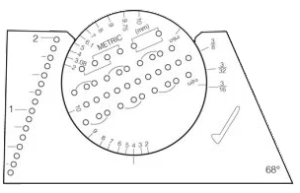
• If you’re hand-lettering use an Ames Lettering Guide. It’s cheap, it’s easy, and it’s indispensable.
Write it. Put it away. Come back to it later. Re-write it.
Nothing is very good in its first draft. That’s why they’re called first drafts. If you’re not re-writing your material, chances are, you’re posting stuff that’s not very good. When you’re re-writing, look for stuff like…
• Spelling and grammar mistakes. I’ll point it out before anyone decides to “out” me. I’m as guilty on this one as anyone else. It doesn’t mean you can ignore this tip, though. It just means I need to pay attention to it just as badly as some of you do!
• Edit, edit, edit. This is comics, people. It’s all about quick, rewarding entertainment. If you can say it in fewer words, you will — nine chances out of ten — improve the reader’s experience. Usually that’s because saying it in fewer words means making better, more descriptive word choices. And that’s Good Writing.
• Remember the visual! We cartoonists have a secret storytelling weapon. We’re presenting images along with out words. Let the two word together. And if the visual is doing its job, get the words out of the way. In other words: show, don’t tell.
• For those of you doing humor: Don’t step on your punchline. Decide where the funniest part in the comic is, and after that — stop! If you write something after the punchline — and it’s not as funny or funnier than the punchline — you just ruined your joke.
With WordPress theme/plugin combos such as ComicsPress and Comic Easel, this stuff should be easy, but it’s not always.
• First screen appeal. We’ve discussed it a lot. Basically, it’s like this. First-timers aren’t likely to scroll down. And if you need to scroll down to read a comic, it’s going to have an adverse effect on how long someone is going to read through your archive. You need to get as much of your site onto the reader’s first-screen view as possible. And that means…
• Ditch that huge header graphic. I’ll be honest with you, the sites I think work the best have a logo to the left of a leaderboard ad across the top of the site. And, really, I don’t know that a comic needs much more than that for branding. After all, the comic itself is going to carry a lot of that responsibility.
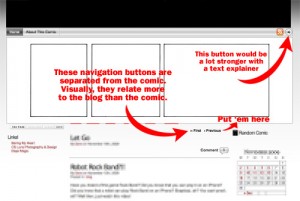
• Put the navigation buttons as close as possible to the comic itself. Personally, I like to see them snug underneath the comic. I also prefer standardized arrows over text (a deficiency I keep meaning to address in my own site).
• The About page. Man, you’re missing out on an excellent opportunity to cement a possible new read if you don’t have this.
Yup, it’s part of webcomics. It’s a big part of how marketing and promotion are done. Not comfortable? Get comfortable.
Here’s the irony: It takes almost zero writing skill. People aren’t looking for the Great American Novel at 140 characters at a time. They want to know about you. What you’re thinking about. What you’re doing. How you feel about that. It doesn’t have to be deep or inspirational or funny — but those kinds of posts are extremely powerful when they come along. But 85% of it is simply sharing your life in bits and pieces.
We discussed this earlier this week. It’s definitely worth a read if you haven’t yet. In short, cargo-cult mentality involves mimicking the actions of successful people — without understanding why those people are doing what they do. If you’re planning your first T-shirt run before you’ve built a sizable audience with your comic, you might be someone who could fall into this category.
If you’re just starting out, you should be concentrating on making an awesome comic — and then doing it with frequency and consistency. Only after you’ve mastered that should you allow yourself diversions such as merchandise.
Hands down, this is the single most important concept to understand for webcartoonists. Nothing is as important as this.
Every day a certain number of people come to your site for the very first time. And they make their decision on whether they will read the comic based on the comic that is posted on that site on that day.
If that comic doesn’t…
• Make sense
• Have importance
• Make an impression
…those readers will leave. And they won’t come back.
“Hey, but what about my archive?”
Have you ever gotten into a disappointing experience and then felt the overwhelming urge to extend that experience?
Neither have I.
Neither will your readers.
They’ll only read your archive if today’s comic intrigues them into doing so.
If you’re doing a longform comic, that may mean that you have to rethink your publishing approach.
If you’re doing a strip, that means every day has to be fantastic. (Or as close to fantastic as you can possibly get.)
If you’re posting something that relies on knowledge of one (or worse — several) days of archived backstory, you will lose that first-time reader on that day.
And if you consistently miss the opportunities to convert those first-time readers, your site will fail to grow — and, potentially, wilt and eventually die.
Sadly, it’s not uncommon for me to see a GoFundMe campaign to help a family in need raise the money for an astronomical medical bill. But recently, I saw a GoFundMe campaign that sought the funds to launch a print comic book. My initial reaction was shock. This was a commercial enterprise in a place typically reserved for charitable donations! But beyond that, it made me sad to think that someone could have such a vast misunderstanding of simple business basics.
Here’s why I think that using GoFundMe to launch a new project is poorly-thought-out…
The content you are trying to access is only available to members.
Note: This post originally ran last year.
In February 2015, I published a post that asked if webcomic creators really needed to host a comments section on their sites. By May of that year, I reported that I had curtailed commenting — and it had numerous positive side-effects for me. This release from NPR.org made it even more clear…
NPR is making an announcement today that is sure to upset a loyal core of its audience, those who comment online at NPR.org (including those who comment on this blog). As of Aug. 23, online comments, a feature of the site since 2008, will be disabled.
With the change, NPR joins a long list of other news organizations choosing to move conversations about its journalism off its own site and instead rely on social media to pick up the slack. But NPR stands for National Public Radio, so a decision to limit “public” input at NPR.org seems especially jarring.
The decision should not be taken to mean that NPR does not value audience engagement, said Scott Montgomery, managing editor for digital news. “We’ve been working on audience engagement, user connections, in a variety of ways, for many, many years, certainly going back to even before the internet. It is a part of public media. It’s important to us,” he told me.
But at this point, he argued, the audience itself has decided for NPR, choosing to engage much more via social media, primarily on Twitter and Facebook, rather than in the NPR.org comments section.
“We’ve reached the point where we’ve realized that there are other, better ways to achieve the same kind of community discussion around the issues we raise in our journalism,” he said, with money, and spending it efficiently, part of the issue. More than 5 million people each month engage with NPR on Twitter, compared to just a fraction of that number in the NPR.org comments. “In relative terms, as we set priorities, it becomes increasingly clear that the market has spoken. This is where people want to engage with us. So that’s what we’re going to emphasize,” he said.
Here’s an analysis of what that means to you…
Living in the Post-Ad AgeFor starters, it’s yet another indication that we’re living in the Post-Ad Age. (I’ll say it again… if you’re still publishing webcomics the way it was done a few years ago, you’re making a big mistake.) Think about it. There’s two reasons to encourage reader comments — Community Building and Ad Revenue. Now that ad blockers have all but killed of anything but the most aggressive advertising, the ad revenue isn’t there to support it.
Back in the day, a webcartoonist could look at a flame war as it broke out on his or her forum and take solace in the fact that it was generating pageviews — and therefore, ad revenue. That’s not the case any more.
But what about Community Building?
Your readers — the vast majority of them — are already spending the majority of their Web-related time on social media. And the overwhelming majority of that is spent on Twitter and Facebook. They’re there. They’re already talking. They’ve already built communities of their own.
If they talk about your comic on their social media, you gain in organic reach what you may have lost in ad revenue.
Put more simply, by encouraging these conversations to take place on social media, you increase word-of-mouth advertising. Do you lose control over the conversation? Maybe. A little.
But let’s face it. Few of us actually used our “control” when we hosted reader comments on our sites. And furthermore, the very act of maintaining a significant social-media presence means that we wield a certain amount of control based on what we choose to share and what we choose to ignore.
Here’s what I mean by that. First, if you’re doing the work you need to do on social media to promote your comic, you’re going to gain organic reach — that is, you can reach a large number of people without paying for an ad or promoted posts. In Twitter, that’s a large number of followers. For a Facebook Fan Page, that’s a large amount of Likes (that you didn’t pay for).
So, when a fan initiates a conversation on social media that you would like to amplify, your retweet or share will do so nicely. And when there’s someone crabbing about something you’d just as soon see drift to the bottom of the social-media sediment, you can simply ignore it. Unless that person has an organic reach that rivals your own, it will die its own natural death.
And, of course, you can encourage — and participate in — the commentary that accompanies your own social-media efforts. This is particularly powerful in the algorithym-driven Facebook. Every like, share, click and comment causes facebook to send that post to a wider and wider sphere of viewers.
The two reasons for hosting reader comments — Community Building and Ad Revenue — are easily dismissed.
Agree? Disagree? You’re welcome to share your thoughts in the comments below.
For now. 😉