February To-Do List
Get out your calendar and start circling dates. It’s time to do a little webcomics planning.
Business
The content you are trying to access is only available to members.Get out your calendar and start circling dates. It’s time to do a little webcomics planning.
Business
The content you are trying to access is only available to members.Webcomics pros Dave Kellett and Brad Guigar are talking comics! In this episode, they discuss what you should do when you realize you’ve lost longtime readers. Then, where should you work, when you work from home? What kind of day job should you have? And finally… how do some cartoonists produce those amazing sketchbooks?
But first… Dave’s going to Alaska Robotics’ Comics Camp!
SHOW NOTES

Writing humor is something many of us grapple with. In the past, I’ve discussed a method that I advocate called Fermentation. And in many critiques and discussions, I’ve found myself advising writers to push or push further or push to the Funny. And every time I write those words, it occurs to me that the phrase is somewhat ambiguous and my advice may be missing the mark.
So I’m going to try to refine the Fermentation method, and I’d love for those of you who are working in humor to try it out and let me know how it worked for you. (More on that later).
Once you’ve written your joke — refined the set-up and fine-tuned the punchline — I want you to leave it for at least 24 hours. I think this is crucial. It allows your subconscious mind to come into play and it brings you in fresh on the next day.
Now, look at what you’ve written and add another panel. Your job now is to use your punchline as a set-up to another punchline. Take the concept one step further. If an action has happened, explore the after-effects. If a surprise was introduced, top it with a bigger one. If the punchline was word-play, warp the words another step.
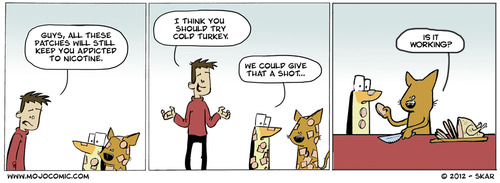
Finally, reduce the comic to its original panel count. Let’s say you do, indeed, produce a four-panel strip. Either lose the fourth panel and go straight from Panel There to Panel Five (making any necessary wording adjustments) or incorporate any crucial parts of the fourth panel into the third panel.
And “crucial” is the operative word here. The point is not to write longer, it’s to write better.
The optimum outcome should be to arrive at a sequence in which the word-count is very similar to the original.
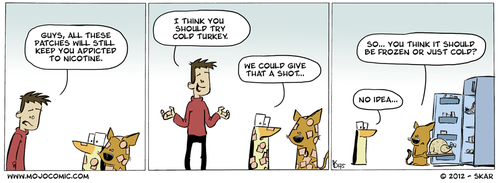
Before I go any further, I want to thank member Oskar van Velden of Mojo who graciously agreed to allow me to use his most recent strip as an example. I noticed Oskar’s update on Google Plus, and it struck me that this was a perfect subject for this conversation because, although the punchline was good, I think it could have been taken to a higher level. Click on any of the images for an enlarged view.
This was Oskar’s most recent comic.

It’s a decent punchline.
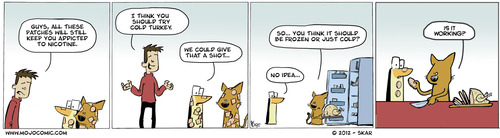
But when I saw it, I couldn’t help but think about how the really funny stuff happened in the unseen next panel.
So, let’s allow our minds to wander for one more panel.

The idea of trying to stop nicotine cravings by slabbing slices of turkey meat on you skin has a really nice silliness to it. And the turkey slices look enough like the nicotine patches to make the concept cross over effectively.
But now it’s too long. The third panel doesn’t do a thing to advance the set-up. It doesn’t charge the tension, and if we leave it in, it actually telegraphs the joke, draining away much of the Funny. Since it’s pretty much extraneous…

I’m not even necessarily saying that this particular fifth panel is the best of all possible fifth panels.
And you could definitely refine it. For example, I might have added a skinny panel between Panel Two and Panel Three in which the penguin and the cat walk away from the man, having removed their patches. It might prevent a reader from thinking that the nicotine patches are being removed in the final panel.
I feel confident in saying that it’s an improvement, but I’ll bet there are dozens of “fifth panels” that you could dream up that take this very good set-up and push the concept to a much funnier place.
I’d love to see this in action. So I’m placing a challenge. Choose one of the following:
(1) Go through your archive and improve a couple strips using the Fifth Panel method. Post Before and After strips here for discussion.
(2) Use this method as your writing future strips, and post the results. The “Before” could be a written script and the “After” can be the finished comic.
If you’re interested in subscribing to Webcomics.com, you can get access to four posts a week containing news, tutorials, information and advice that applies directly to your career as a cartoonist — plus the private forum and exclusive member benefits.
A $30 membership gets you access for 12 consecutive months. But if you’d like to try it out for a month to see what you think, you can get a no-strings-attached one-month trial membership for five bucks.
Still on the fence? Scroll down. You won’t be able to read the full articles yet, but you can see the diverse topics and useful information that make this site a daily stop for so many working cartoonists.
Dave Kellett and Brad Guigar are talking comics! In this episode, Brad makes another lasting contribution to webcomics: Guigar’s Law — The first person to comment that they’d buy a certain type of merchandise is the first person to disappear when the merch is offered!
BUT FIRST, Brad and Dave fondly remember comic-convention cosplay.
Show Notes
Launching your Patreon Here’s a helpful guide to all of the ComicLab episodes with advice on launching your Patreon. See the Show Notes for each episode to see where we start talking about the topic you’re looking for. Remember, of course, the Golden Rule of Crowdfunding from last week’s Lightning Round: Build an audience first. It’s right there in the word — you have to have a crowd before you can have funding.
Whether you’re trying to write a more compelling story — or trying to punch-up a joke — elevating the conflict is often the key to success. Conflict is at the heart of both comedy and drama. But conflict alone doesn’t create the narrative tension that is so vital in good storytelling. So let’s take a moment to examine narrative tension in detail.
The content you are trying to access is only available to members.To be honest, it was a tip that I passed along, but personally dismissed. Patreon had been insisting that they had a simple way I could improve my ability to earn backers, but it was so simple, I decided it couldn’t be that important. I was wrong.

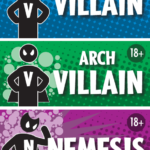
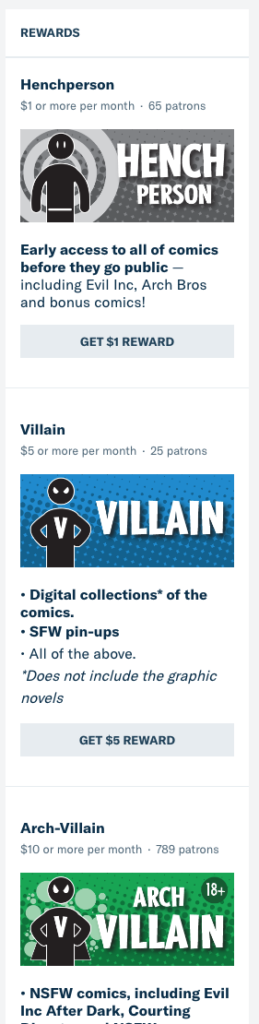
For months, I was hearing that improving the design of my rewards tiers would bring a bump in the number of backers I was earning. Specifically, I was hearing — from Patreon themselves as well as peers whose work I admired — that adding images to my reward tiers would have a pronounced effect on my pledge numbers. Shortening the explanations under those tiers — down to bullet-point-style blurbs — would also improve my standing.
So, with a little time I found myself with over the holiday break, I created some images to represent each reward tier and added them to my Patreon page. (These should be 460 x 200 pixels.) I also shortened the explainers under each tier significantly. What used to be paragraphs now became a list of bullet points.
I was, frankly, shocked at the immediate response — especially in my $1- and $5-tiers, which had underperformed over the past few months.
I also recommend carrying that same mentality over to the body text of my Patreon page. Again, I use bullet points to convey large amounts of information quickly. I’m also a big fan of using an informational graphic to elaborate on reward-tier details.
The beginning of your story should hook your readers. If a story starts off boring, why would anyone want to keep reading? That’s why it’s so important to take a little time and craft the opening pages of your comic. Those pages are crucial to engaging a reader, and keeping them interested in your ongoing narrative.
The content you are trying to access is only available to members.Dave Kellett and Brad Guigar are talking comics! In this episode, they discuss best practices for sound effects and promoting longform comics on social media. NEXT, they discuss “Chapter Zero” — what it is, and whether it’s right for you. THEN it’s strategies for coping with the Q1 slowdown. AND FINALLY, they take a handful of questions from 2018 and drill through them in a Lightning Round!
BUT FIRST, as Dave prepared to receive a shipment of books for his latest Kickstarter campaign, he learns something about his co-host’s tipping habits.
According to author/journalist Christopher Booker, there are seven basic plot types that recur throughout every kind of storytelling. It’s a pretty amazing theory. We’ve been telling the same seven stories over and over again — just with different characters and situations. Understanding these narrative archetypes can help give our own writing shape and structure. So let’s discuss them…
The content you are trying to access is only available to members.Sometimes the hardest thing about writing a story isn’t coming up with a grand arc that challenges and changes your main character. Sometimes the devil is in those little details along the way — all of those myriad decisions you have to make that delivers your character to the climax. Let’s talk about that.
The content you are trying to access is only available to members.