November To-Do List
It’s time to get started on (*choke*) the penultimate month of 2015.
The content you are trying to access is only available to members.
It’s time to get started on (*choke*) the penultimate month of 2015.
The content you are trying to access is only available to members.
You don’t need a subscription to read today’s post!
This is a re-post from the Webcomics.com archive. If you’ve ever been curious about the kind of information, tutorials and advice that you’ll get as part of your subscription to Webcomics.com, this is a good example.
If you’d like to join the site, you can get a 12-month subscription for $30 — or you can get a one-month Trial for $5 … with no obligation after your 30 days expire. For less than three bucks a month, you can get a steady flow of information, tutorials and advice targeted towards your webcomic business — plus a private forum to discuss issues with other professionally minded cartoonists.
When webcomics started out, longform creators felt like the ugly ducklings in the crowd. Many of them expressed the same complaint when I’d talk to them. They just didn’t feel as if the Web was the right place to present their work to its full strength. However, I think the Web— and its users — have both improved and matured to a point that longform comics not only can survive — but thrive — on new platforms (such as eComics).
But it kills me — kills me — when I see longform-comics creators continually trying to present their work in the “traditional” webcomic set-up that was heavily geared towards strips and other short-form comic. It’s a classic square peg scenario.
I think longform comics are on the cusp of a real revolution, and the artists who are going to best position themselves to take advantage of this will be the ones who will adapt their publishing approach to a new way of thinking.
Here are a few thoughts on where I think that new way of thinking should go.
Pages are the units of a book. Updates are the units of a Web site. The two are not interchangeable.
If you’re posting the pages of your book on the Web, I think you may be making a mistake (unless you’re planning those pages very carefully).
Your Web site itself (and the reading experience on a Web site) is not conducive to book-reading. And if you want your Web site to flourish, you’re going to have to create the best-possible reading experience on that site — not a book-reading experience that you shoe-horn into a Web site.
Make sense.
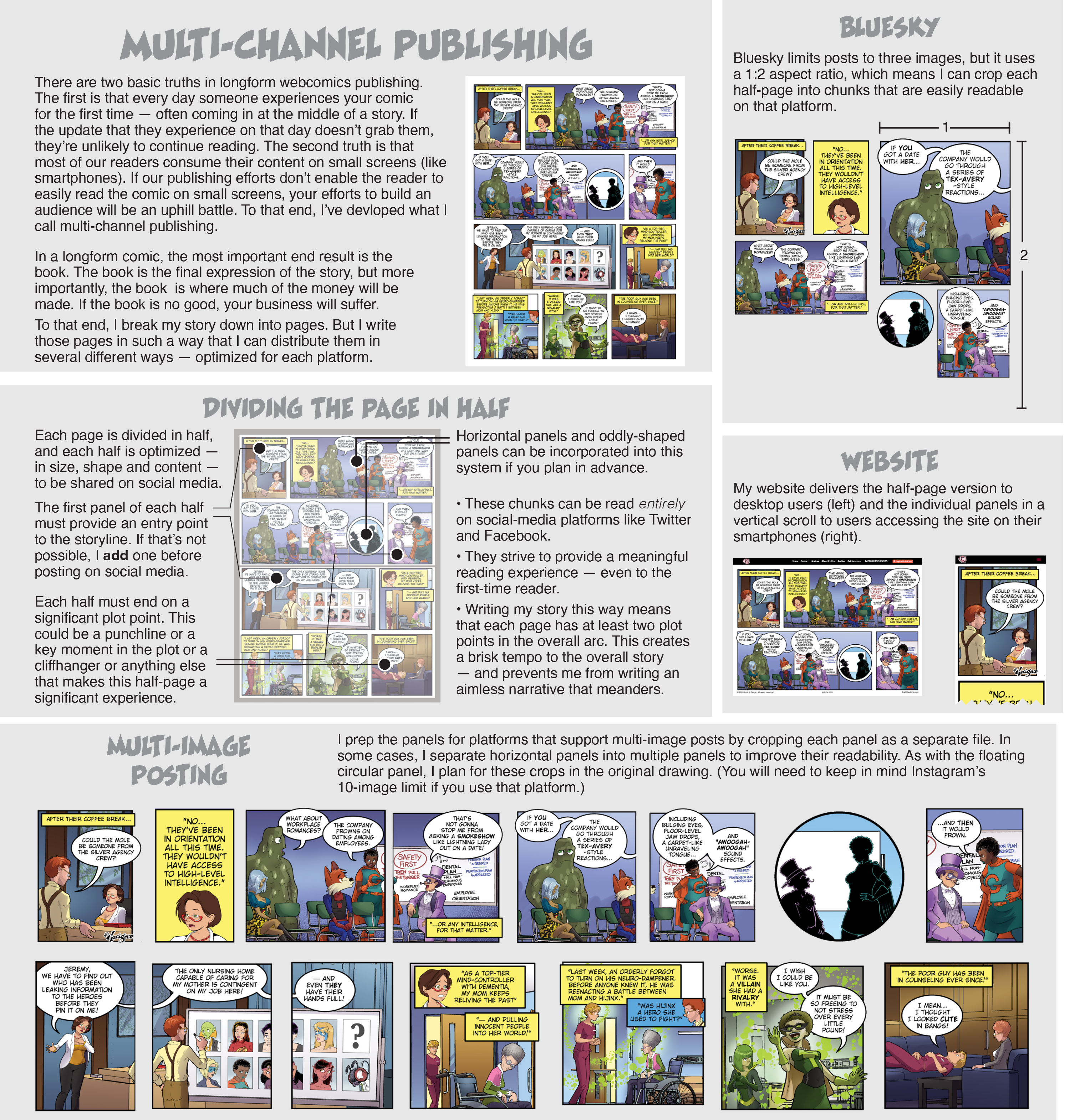
UPDATE = HALF-PAGE
Now there are a lot of ways to do this. I’m particularly fond of Scott Kurtz’s approach at Table Titans, and I strongly urge you to give it some thought. Every update is a half-page of the book he will later release. And every update has a significant element to it — a punchline, a plot hook, a cliff-hanger, etc. He writes the comic with the site/book polarity in mind. He knows that every update has to be important for the site, and he knows exactly how those updates fit into the overall book (top of page, end of right-hand page, etc.).
And this guides his writing. If he needs another update to make a two-page spread work right in the book, for example, he’ll do that. And he’ll make sure it’s significant for the site — at the same time that it fits into the storytelling of the book.
Challenging? Absolutely.
Impossible? Absolutely not. It’s just a new way of thinking about storytelling.
SLIDING SCALE UPDATE
Here’s another option: You simply release your graphic novel in significant updates. And if that means releasing two panels today and a page-and-a-half on the next scheduled update day, then that’s what it means.
This approach takes less planning in the writing stage — and allows you to keep the storytelling in the book “pure.” But it’s going to put you in a tight spot sooner or later as you run out of finished, significant updates to post.
FILLERS, SKETCHES, GUEST ART, ETC.
This is poison to the Web-reading experience. You fool yourself into believing that you had a post up for your readers that day — and, to an extend you kinda do. But that crap lives forever in your archive, taking readers out of the spell that you’re trying to weave as a storyteller.
Please don’t settle for this in leiu of doing a little planning and time management. You’re hurting yourself.
I think a longform-comic creator should give seriosus consideration to instituting a landing page as the main page of their site. I go into this subject in greater detail here.
The Frequent/Consistent/Significant rule will always apply to a comic on the Web. There are no special dispensations for longform comics. Every update has to be updated as frequently as it possibly can be, while maintaining consistency (of quality and schedule) and significance of each, individual update.
That’s another challenge — to the writing for sure — and to the comics-creation process overall.
But here’s where I think the payoff is…
Digital tablets are so widespread as to make them almost an assumed possession among our readers.
And it’s so freaking easy to sell digital downloads — either independently, through sites like SendOwl and Gumroad, or through online distributors such as ComiXology and DriveThruComics — that you literally don’t have an excuse to avoid it any longer.
A longform-comic Web site, therefore, should be set up in such a way that readers (even new ones) instantly understand the following:
That’s the user experience you have to set up — in the first screen view of your site.
Again, that’s going to take some planning — and some excellent time-management skills. But I think there’s a way that longform creators can make this work.
What I see as a possibility is a publishing cycle that (a) identifies the time-constraint placed on the callenges I laid out above, and actually (b) builds in the extra time needed to make this happen. Here’s the cycle:
PLANNING
The book is planned, plotted, and outlined. You know where the story is going conceptually, but more importantly, you know how many updates you have (and, on the other side of the coin, how many pages you’ll have for your impending book/digital download). You don’t have to have every last word written, and there’s a little room for wiggle, but you have a strong outline against which you can plan your approach.
And since you have a plan, you can now determine:
LAUNCH
Once you’re ready, you now launch your longform comic. You make an announcement. You hit inbound social media* as hard as you can. You send preview comics and press-releases out to sites that cover comics news. And you have reader-grabbing updates in place to… well… grab those readers your driving to your site.
* Your Twitter feed, your Facebook page, etc… all sending traffic “inbound” to your Web site.
PUBLISHING
This looks more like “traditional” webcomics publishing. You have ads on the site to generate income. You’re facilitating social-media evangelists through outbound social-media buttons (ones that allow users to share your work with their friends). You’re facilitating comments and other Community Building aspects of webcomics. You’re running a webcomic, except…
PUSH THE DIGITAL DOWNLOAD
…where a traditional webcomic would encourage readers to dive through the archives, you’re making sure they know they can read previous chapters (or even previous books, issues or volumes) by purchasing digital downloads. These links are prominent, and your “message” on the site, social media, etc. reinforces this fact.
CONSIDER THE PRE-RELEASE
Of course, if you’re updating on the fly, you’re getting updates finished just in time for publication on your Web site. But if you’ve planned ahead, you can offer interested readers the entire chapter (or book) as a digital download — which includes the stuff that’s already appeared on the site as well as the rest of the content they haven’t seen online, all the way to the end of the chapter/book/etc.
THE FINALE
At the grand finale, we have the completed piece (chapter/book/etc.) available as a digital download. If a printed version of the comic is in your plans, this is when you launch the Kickstarter. You have a product in hand, a dedicated reader base, and a clear path to your product. These are all important ingredients to a successful crowd-sourcing campaign.
DORMANCY
And now you go dormant. Well, not completely dormant, but the activity on your site slows down. You convert it from an active webcomic to a storefront for your digital download(s). Make sure there’s a message explaining when the next live content will begin appearing on the site. And you can even post teasers for the next round with sketches, etc — as long as they’re not included in your comic’s archive.
During the “dormancy” period, you go back to “PLANNING” and start the entire process over again.
You won’t be getting as much ad revenue, but as you’re doing the planning, you should also be focused on selling that chapter/book that you’ve created, and that’s going to be the revenue stream that sustains you during “dormancy.” You’ll be pushing the content out through all of the channels you can, too — ComiXology, DriveThruComics, apps, etc. And, of course, the Kickstarter money for the book — and the subsequent sales of that book. All of this is your revenue during “dormancy.”
Then you do the whole thing over again.
Now, obviously, there is a wide range of longform comics, and this probably won’t apply to some. However, I think there are elements there that could apply to all of them. And there are creative people who will take that framework and run with it.
But that’s my thoughts on running a longform comic on the Web. What are yours?
A subscription to Webcomics.com is only $2.50 a month when you subscribe for a year. Not sure? Try out the site risk-free for five bucks.
It’s hard to believe it, but we’re sliding right into the holiday-shipping season again. For some of us, that means positioning our merchandise as gift ideas and shipping according to holiday deadlines.
Here’s a quick primer to get you off on the right foot.
The content you are trying to access is only available to members.
Here’s a handy pro tip for people running Patreon campaigns. If you’re like many of us, you love Patreon, but many aspects of navigating the Creator Feed are… lacking. And you want better for your backers. So — once their payments have processed — you send out a link to a Dropbox folder so your backers can access the exclusive content outside of Patreon’s clunky interface.
Of course, once that link is out there, anyone could use it to access that content. And that’s a little troubling.
This pro tip is for you.
The content you are trying to access is only available to members.
Patreon has released new apps — for iOS and for Android — and it has features for both creators and backers. Here’s a quick primer.
The content you are trying to access is only available to members.
You don’t need a subscription to read today’s post!
This is a re-post from the Webcomics.com archive. If you’ve ever been curious about the kind of information, tutorials and advice that you’ll get as part of your subscription to Webcomics.com, this is a good example.
If you’d like to join the site, you can get a 12-month subscription for $30 — or you can get a one-month Trial for $5 … with no obligation after your 30 days expire. For less than three bucks a month, you can get a steady flow of information, tutorials and advice targeted towards your webcomic business — plus a private forum to discuss issues with other professionally minded cartoonists.
I’ve been working though Google’s Digital Analytics Fundamentals workshop. It’s a free online course that is designed to help you use and understand Web traffic data better, and I highly recommend it.
One of the repeated themes is that you need to know your business objective(s) before you can implement intelligent data tracking. And that’s where I came to a bit of an existential crisis: What is the business objective for my webcomic?
It sounds funny… do be doing something for this long and to be unable to easily answer the question, but to be honest, I was a little torn between two choices. On one hand, the easy answer is that my business object should be that of a typical content publisher: Encourage frequent visits from new and repeat users. On the other hand, it’s very tempting to say that my business objective was that of an eCommerce site: Sell products — in this case, printed books and digital downloads.
My core business revolves around the former, but expanding the latter would definitely be a good thing.
It’s not such an easy answer, is it? I mean, the knee-jerk response is to define oneself as a content publisher — and for good reason… that’s exactly what we are. However, it’s very tempting to see the effect of considering one’s site as an eCommerce site, with the objective becoming using that daily comic to drive sales of books, T-shirts and other merchandise.
I’m not sure that there’s a right answer — and I’m not sure that the two are mutually exclusive. In other words, I believe one could have an objective of a content publisher and track sales of merchandise as an indicator of successful audience conversion. Conversely, you could think of yourself as an online merchant and think of the comic as a way to attract potential customers, tracking those metrics accordingly.
In the end, I’ve decided that the objectives of a content publisher better suits my business, but I’m throwing the discussion out to the group:
What’s the better description for your webcomic — Content publisher or eCommerce site?
A subscription to Webcomics.com is only $2.50 a month when you subscribe for a year. Not sure? Try out the site risk-free for five bucks.
One of the features of the new iOS update released by Apple this month was the News app.
It collects news posts from around the Web, based on your interests, and collects them in a handy feed.
Since this is yet another potential audience for your comic, here’s how to get your RSS feed noticed by the app.
The content you are trying to access is only available to members.
Scott Kurtz, Cory Casoni and I discuss the rise of the ad blockers. How did we get here? And what does it means for Web publishing?
There’s another video circulating about creator’s rights that has some folks in the webcomics community worked up. This one concerns the TPP.
It raises some questions: Should creators be worries about the regulations set forth in the Trans-Pacific Partnership?
The video is pretty hard to get through. Skip to the 2-minute mark to avoid the preliminaries.
The content you are trying to access is only available to members.
You don’t need a subscription to read today’s post!
This is a re-post from the Webcomics.com archive. If you’ve ever been curious about the kind of information, tutorials and advice that you’ll get as part of your subscription to Webcomics.com, this is a good example.
If you’d like to join the site, you can get a 12-month subscription for $30 — or you can get a one-month Trial for $5 … with no obligation after your 30 days expire. For less than three bucks a month, you can get a steady flow of information, tutorials and advice targeted towards your webcomic business — plus a private forum to discuss issues with other professionally minded cartoonists.
In 2009 — in the very early days of this site –I wrote a post that was titled Writer’s Block: It’s a Myth. It was a terrific lesson for me about choosing a clickbait headline for my posts. See, I chose a sensational title to grab people’s attention and generate links (this was before the site switched to a subscription model). And the headline did just what it was intended to do. It stirred up excitement — much of which was in the form of anger from people who had experienced serious problems advancing their writing that felt very real and un-mythlike to them.
The content of the post, however, holds a very good thought to keep in mind for those times that you experience writer’s block:
It’s worth a read, if you haven’t yet. But I’d like to move past identifying the problem and push forward to sharing some strategies to getting your creativity flowing during those times when it’s just not happening naturally.
Here are some excellent strategies for getting your creativity started:
PUT PENCIL TO PAPER
For many of us, creativity is intrinsically linked to the act of making marks — writing and/or drawing. When I look back on the times when I felt my creativity had stalled, there’s a common thread — I was unable (or unwilling) to start the physical process.
So snap out of it. If you’re trying to write, start a sentence. Or re-start the sentence that you’re working on a difference way. Use different words or put them in another character’s mouth.
If you haven’t even gotten that far, don’t underestimate the power of idle doodling. Start a sketch and follow it where it goes. Fill your page (or several pages) with nonsense, free-associative sketches. It’s amazing how much inspiration comes springing out of this process.
CHANGE YOUR PROCESS
If you write in one particular setting, find a new place. For example, if you write at home, go to the park — or a coffeeshop. If you write during the day, switch it up and write at night. But be careful: Make sure you’re still actively pursuing the writing process and not simply avoiding it. In other words, a trip to Starbucks can inspire your writing — but only if you actively try to write while you’re there. If you spend the entire time chatting up the barista or simply staring out the window, you’re doing more avoidance than actual writing.
DO SOMETHING MINDLESS
Clean your room. Fold the laundry. Rake the leaves.
But do these things without the usual headphones or background noise.
Allow yourself to do these things in total quiet. Once your hands are busy, your mind will wander.
GET BORED
I love it when my kids tell me that they’re bored. Because necessity may be the mother of invention, but boredom is the father of creativity.
So let yourself get good and bored. Turn off the music. Unplug the TV.
Oh, and get far, far away from anything that will deliver you the Internet.
Remove all the distractions and then get beautifully bored.
Your mind will find something to do. All you have to do is direct it.
GIVE UP
If you’ve spun your wheels for an hour or so — and I mean really, really tried to get some creativity happening — give up. For now. Do something else that makes productive use of your time. For me, that often means pencilling some of the strips I’ve already written. Or do something that needs to be addressed for your business (are your receipts organized and filed so you can find them during tax season?). Or make that improvement to your Web site that you’ve been putting off. Just make it a point to come back to writing at your first opportunity and try again.
EXERSIZE
Get your heart rate up and keep it up. Get a good, long, tiring workout in. And then, once your body is good and exhausted, sit yourself down and write.
SUGAR AND/OR CAFFEINE
Not a health nut? Stop by Dunkin Donuts and pick up a large coffee and a donut. The resulting buzz can propel you into a little chemical-induced creativity.
Before you take this as a license to write off bad eating habits as the cost of doing business, keep this in mind: This works best when the sugar/caffeine comes as a jolt to your system. If a coffee and a donut is part of your routine breakfast, it’s hardly going to be a jolt.
AND…
What about you? Do you have a tried-and-true creativity jumpstarter? Hit the Comments and share below!
A subscription to Webcomics.com is only $2.50 a month when you subscribe for a year. Not sure? Try the site out risk-free for five bucks.