Last month was an excellent example of the tremendous value offered by a subscription to Webcomics.com. My readers got early alerts on issues that would impact their businesses, helpful tutorials, insightful analysis, and meaningful feedback on their work. Here are some samples of what you may have missed…
What if I told you the algorithm is your friend?
We all hate the Facebook algorithm. Why? Because it keeps our messages from going out to all of our followers.
What if I told you that the Facebook algorithm — in fact, most social-media algorithms — was your friend. What if I told you it was an ally? What if I told you it was even more than that? Would you think I was crazy?
The 2018 Eisner Award nominees have been announced. Here’s the entire list. Of special interest are the nominees for Best Digital Comic and Best Webcomic.
“How do you study to improve and how do you fit that study into your schedule?”
That was the tweet of a cartoonist who was trying to figure out how to find more time to learn the craft. I checked his Twitter feed from earlier that day. They had posted twentytweets that day alone — counting replies to tweets, that number went much, much higher.
Earlier this month, I was actively promoting a Kickstarter, my Patreon, my comic, two podcasts, this website, and god-knows-what-else (making sure I was covering each of the Three Cs…). During that time, I rarely came close to 20 tweets in a day.
This person has the time to devote to learning comics, they’re just not using it.
Forget the Stretch Goal. The Add-on is where it’s at! I was a huge fan of this strategy before, and now that I’m using Backerkit, I’ve been able to use it to tremendous advantage.
A Webcomics.com member posted rather excitedly about his experience with the BuyMeACoffee app.
It took me about twenty minutes to set up and place link buttons on my sites. Without saying anything to anyone I got my first tip within 12 hours.
“Without saying anything to anyone I got my first tip within 12 hours.” That’s impressive as heck! Then another member chimed in saying that he had been encouraged to register an account with the app. And the next day, he posted a follow-up: “DING! Someone just ‘bought me a coffee’ today!”
Getting that kind of immediate action is tremendous. Hearing about it happening twice within the Webcomics.com community got me wondering, though.
Then, I started doing some very simple social-media searches. What I found made my jaw drop…
Today is the tax deadline. You must file your federal income tax return today (along with any state and local taxes that are due).
But what if you owe money and can’t pay? Don’t make a bad situation worse. This could end very badly if you handle it improperly.
It’s understandable.
You’ve gotten into a bad situation — you owe taxes but can’t pay. But don’t make it worse by avoiding the filing deadline. There’s a right way and a wrong way to handle this situation…
I knew I had touched a nerve when I tweeted a conversation I had earlier with a fellow cartoonist…
Brad Guigar
✔@guigar
Cartoonist: Every time I mention Patreon on an Instagram post, I lose followers!
Me: Good
C: ?
Me: I’d rather have 1k followers who want me to succeed than 10k who’d drop me for that. The folks who left did you a favor. More room in the algorithm for you to reach the right people
As crowdfunding takes an increasingly dominant role in webcomics revenue, more and more independent creators are turning to tools like Patreon to fund their work. But launching a Patreon page can feel daunting. Here are some steps you can take to ensure that you’re starting out on the right foot.
“I’ve been trying to do the whole Curating thing like you’ve been saying (primarily on Facebook), but I haven’t noticed any difference.”
That was the comment from a webcartoonist who was struggling to get traction on social media with their comic. When I looked at their Facebook page, I realized that we needed to have a discussion about two topics:
Understanding Curation better
Understanding the WHY
With their permission, I’m going to share some of our conversation because I think it points to some universal misunderstandings about how social media works.
Managing a successful Kickstarter campaign boils all down to planning. The time you spend in the weeks (and months) leading up to the launch can help ensure you hit your goal. So, let’s talk about Kickstarter strategies that really work well…
To me, there’s no quicker way to firmly establish your amateurishness — your desperation— than to end a social-media post with a long string of generic hashtags. There are a few exceptions. Instagram, for example, seems to make hashtags a requirement. But even then, conventional wisdom says that more than seven hashtags will get penalized by the app’s Facebook-influenced algorithm.
But as I scroll down my various social-media feeds, I realize that it’s really not hashtags themselves that bug me. Rather, it’s the unimaginative, lazy, knee-jerk way that we webcartoonists tend to apply them.
So, let’s talk about how we can up our #hashtag game.
Q.: I’ve started a Wix site for my webcomic but I’m a bit stumped when it comes to getting views on my website.
I’ve already filled out the SEO stuff (limited as it is for a free site) so I can’t do much more there. And added some social media buttons.
I’d like some ideas on how I can get views or where and how I can advertise to get views.
A.: There’s not a webcartoonist alive who doesn’t ask themselves that question. Heck, I would imagine it applies to any creative profession. It’s one of our very few Universal Sentiments.
But it’s a mindset that misses an important point, and until you understand it, I think it’s going to hold you back.
What I think you’re missing is this: You’re already getting new readers. Every day. The question you should be asking yourself is whether you’re keeping the new readers you doget. And if that answer is no, you have to take a long, hard, objective look at why that is. If you think your comic is good — and if you’re not keeping new readers — then maybe it’s not as good as you think it is.
The Eisner Award nominations were announced, and there’s a lot to talk about! Then it’s on to questions from out Patreon backers. In a social-media landscape that favors branding the creators themselves over their creations, it it OK to have a pen name? And what’s the best approach to warm-up sketches?
BUT FIRST… Brad hit a monster pothole on a winding Philadelphia thoroughfare, rupturing the tire, forcing him to pull over on a road with no shoulder and wait for AAA Roadside Assistance for over an hour as cars swerved around the curve, narrowly missing collision after collision.
And it was his in-laws’ car.
Show notes
0:00 — Brad hits a pothole in his in-laws’ car
10:56 — There are now 5½ hours of ProTips!
13:02 — Dave’s recording in his closet. And getting no respect.
What if I offered a small promo box that participants could add to their site. The box would randomly generate a small banner and link to comics from other participants.
Are you in or out?
I think the answer should be out.
Why aren’t you asking these questions?
If your first response is to jump into this arrangement, you’re making a poor self-promotion decision. I discussed a couple of the worst in this episode of Webcomics Confidential…
Instead of jumping right into this arrangement, your first instinct should be a barrage of important questions:
Who is going to be accepted into this group?
On what kinds of sites will your ad appear?
Who will enforce compliance?
How can you avoid inappropriate content on your site?
How will you handle the perceived endorsement that such promotion implies when your readers find inappropriate or low-quality content there?
And that’s just the initial salvo. Let’s cover some of the standouts.
You are judged by the company you keep
This is the primary reason to avoid such an arrangement. Many of these questions boil down to one central issue: You’re judged by the company you keep. Your comic appearing on a low-quality webcomic makes your comic look amateurish. Don’t fool yourself. That’s why I always advocated against hosting your comic on sites like Drunk Duck (are they even still around?) and Smack Jeeves. If you allow your product to be showcased along with low-grade content, then you will be perceived as being low-grade. It’s pretty hard to escape.
Here’s the other side of that coin — when you endorse a low-grade comic on your site, you are putting yourself in that same company. You are telling your readers who you are — and it’s an insult.
I know. I know. There’s gonna be someone who says…
“Hey… anything to get my work out there!”
That’s pretty pathetic. It’s the thinking of an amateur. And it’s a great way to ensure that you’ll never progress beyond that point. What you become is a direct result of how you think.
Inappropriate content
Oh, sure. I’m sure they’ll keep out porn (those monsters) and excessive violence. But what about politically-charged content? If your comic embraces philosophies from one end of the political spectrum, how are you going to feel when you see ideals from the other side of the spectrum appearing on your site? Worse — how are your readers going to react?
Compliance
Although it’s completely dishonest and shady, I’ll tell you the only “good” way to participate in this kind of arrangement. Submit a promo, engage in the system, add the widget to your site, let it run for a couple weeks, and then quietly delete it. Your ads are now in the system, being distributed by the saps, and you don’t have to run their crap on your site.
I’m a complete moron and I figured that one out in about thirty seconds. How many of the people in the group are at least as smart as me?
And although some of those people may be uncomfortable with deleting the widget entirely, how many of them are going to quietly slide the promo box further and further down their page over time?
Uneven participation
Let’s say two people participate. One has been doing webcomics for five years and has a strong daily readership. The other started yesterday. Who benefits from that arrangement.
The person who brings the most to the table gets rewarded the least.
It’s lazy
Sorry, folks. Good promotion takes a little more time than plopping some HTML onto your website and hoping for the best. Having your comic’s promotion appear anywhere isn’t nearly as effective as honing a message and aiming it at a carefully targeted demographic. But the former takes about fifteen minutes, and the latter takes much, much longer.
Dave and Brad field some tough questions about the best ways to handle negative comments and clingy fans. They also discuss using Instagram stories for comics promotion and strategies for writing longform comics
But first, following up on last week’s fascination with the “B.C.” comic strip, Brad tells Dave about how the Flintstones used to do in-show smoking commercials?
Show notes
3:24 — “The Flintstones” did smoking commercials
6:19— Brad gets a bicycle, and that touches off some memories
13:39— Audio Question: What about Instagram Stories for promoting comics?
22:15— Building a webcomics career is a little like building “drip sandcastles.”
26:47— Handling negative comments
41:37— Strategies for writing longform comics
45:42— Writing yourself into a corner. On purpose.
“How do you study to improve and how do you fit that study into your schedule?”
That was the tweet of a cartoonist who was trying to figure out how to find more time to learn the craft. I checked his Twitter feed from earlier that day. They had posted twenty tweets that day alone — counting replies to tweets, that number went much, much higher.
Earlier this month, I was actively promoting a Kickstarter, my Patreon, my comic, two podcasts, this website, and god-knows-what-else (making sure I was covering each of the Three Cs…). During that time, I rarely came close to 20 tweets in a day.
This person has the time to devote to learning comics, they’re just not using it.
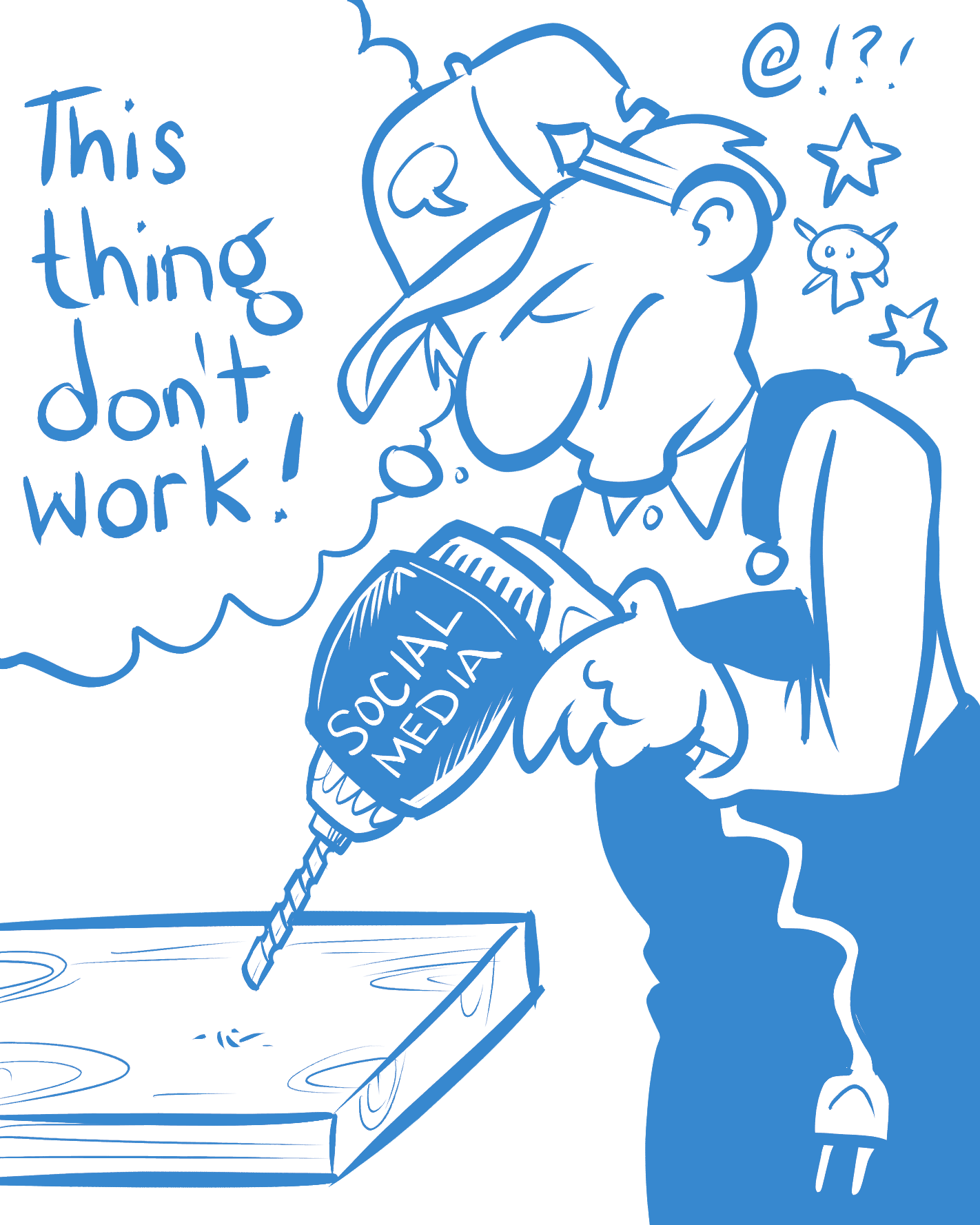
For webcartoonists who are trying to improve their skills, I think social media is doing more harm than good.
The content you are trying to access is only available to members.
We all hate the Facebook algorithm. Why? Because it keeps our messages from going out to all of our followers.
What if I told you that the Facebook algorithm — in fact, most social-media algorithms — was your friend. What if I told you it was an ally? What if I told you it was even more than that? Would you think I was crazy?
Pull up a chair.
The content you are trying to access is only available to members.
Forget the Stretch Goal. The Add-on is where it’s at! I was a huge fan of this strategy before, and now that I’m using Backerkit, I’ve been able to use it to tremendous advantage.
Whenever a Kickstarter campaign attains its goal, it’s expected that the creator will announce a Stretch Goal. I know that was the expectation when I hit my funding goal with two weeks of campaigning to go. But I really didn’t have a good Stretch Goal lined up. My readers have never strongly supported merchandise outside of the graphic-novel line, so maquettes, action figures and toys were out.Heck, I’ve never even seen a strong enough demand for hardcover editions to justify that expense. Besides, adding all of that stuff to the mix means accounting for extra shipping expenses, and I wasn’t certain that I was going to be able to hit a Stretch Goal if it accounted for all of the extra money that would be needed.
And — really — now that I’ve reached my goal, isn’t it wiser to simply run up the numbers for the current Kickstarter? I mean, I have a three-volume omnibus book that I want to pitch to my readers, but I think it’s better to let that stand on its own merits — with its own Kickstarter.
However, I did want to maximize the money I’d be able to generate in the next two weeks of Kickstarter funding.
And that’s when I discovered the beauty of the Add-on.
The Kickstarter Add-on was pioneered by tabletop-gaming project creators, who have used them to allow backers to add expansion packs, extra cards and game pieces. Since then, add-ons have become popular for projects in every category.
I offered a single Add-on — a PDF that collected the NSFW comics I was doing for Patreon since last April. I alerted my Kickstarter backers that it would be available as a $20 add-on. That announcement went out on April 7.
Three days later, I’ve seen $720 in increased pledges.
How does the add-on work?
Easy peasy…
Instruct them to press the ‘Manage Your Pledge’ button on the Kickstarter page for the item. If they haven’t pledged yet, this will say “Back This Project.”
Instruct them to increase your pledge by $XX. TELL THEM NOT TO CHANGE THEIR REWARD TIER.
After the Kickstarter campaign has ended, you will send out a survey. If a backer pledged at least $XX over their reward tier, you will give them an opportunity to indicate that, and then will send them the PDF when you fill their order.
Go digital
To maximize the impact of this add-on, it should be a digital reward. If that’s not feasible, it should at least be something lightweight that will not significantly increase the shipping cost of the item. Remember, Media Mail rates are applicable only to bounded, printed material. If you throw something different into that package, it no longer qualifies for Media Mail rates.
Preorder
Keep in mind… a Kickstarter is basically a preorder on a line of merchandise. If the Kickstarter is successful, you’ve covered the start-up costs on that merchandise. If that happens early, it’s risky to try to launch a second piece of merchandise at the same time — especially if you haven’t properly gauged the extra cost and/or the demand.
I think it’s much wiser to simply maximize this preorder cycle, and let that second line of merchandise stand — or fall — on its own merits.










 Loading ...