Writing a good joke is a balancing act. There are so many ways to upset the delicate harmonies that work together to make something funny. Luckily, there are a few missteps that have recognizable patterns. One of them is telegraphing the joke.
The content you are trying to access is only available to members.
It’s pretty easy to see the influence of manga on comics being produced today. Scrolling through Webtoons, it’s obvious that an entire generation of young comics creators cut their teeth on comics originally made in Japan. In general, that’s tremendous! The creativity, the kinetic energy, the jaw-dropping art — it’s all worthy of emulation.
But when it comes to word balloons, something’s getting lost in the translation.
Cargo Cults
I discussed Cargo Cults recently on Webcomics Confidential.
In short, Cargo Cult thinking happens like this:
A person sees someone else doing something enviable
That person mimics the actions without learning why (or how) those activities produce the outcomes they desire
Often these mimicked actions has unintentional consequences
We’re all guilty of cargo-cult thinking at different stages of our progression as cartoonists. It’s a pretty natural way of learning behavior. However, it’s those unintended consequences that cause problems.
Lost in translation
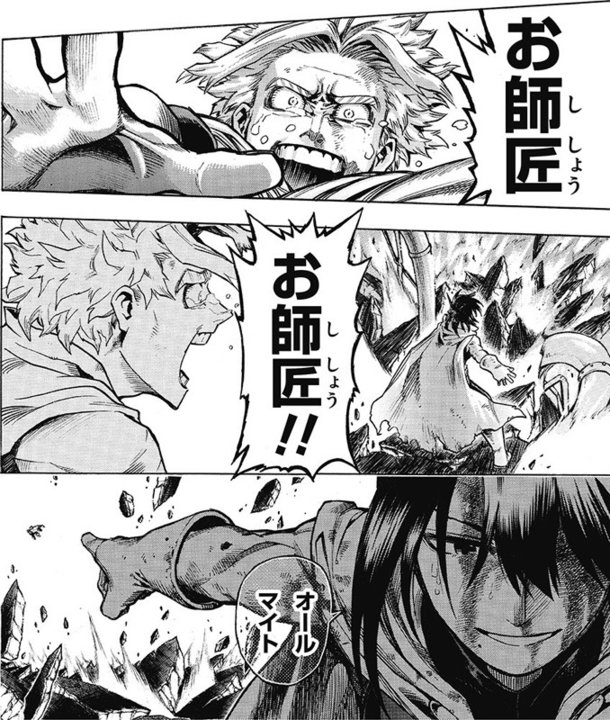
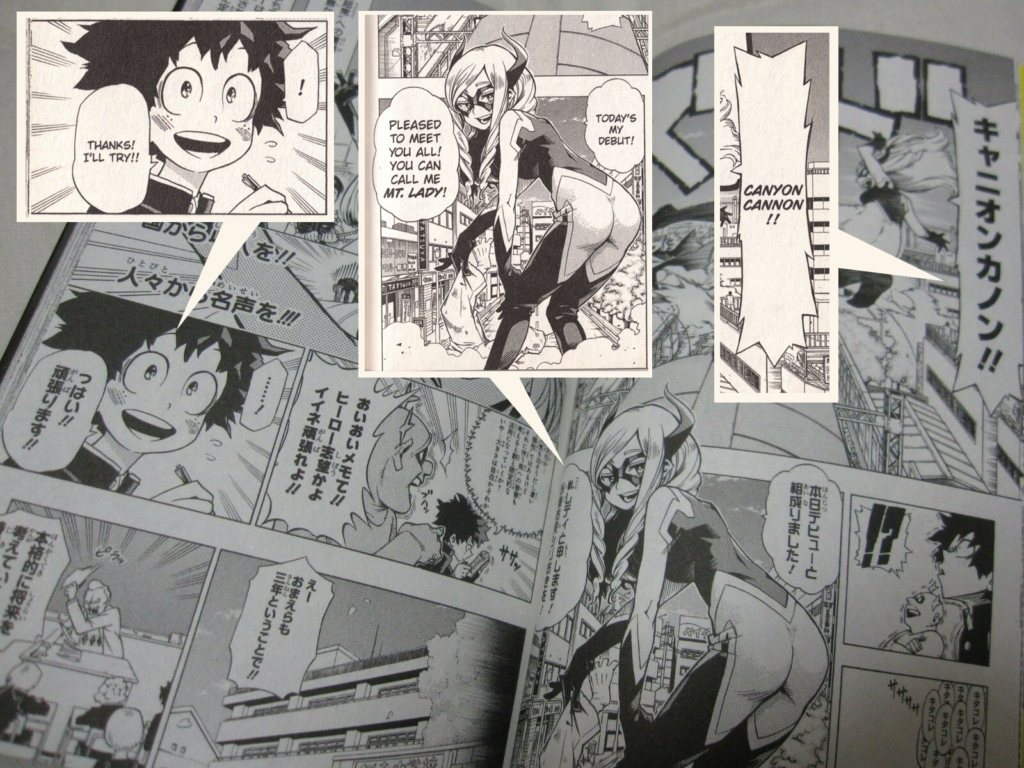
SOURCE: My Hero Academia
As any manga fan can tell you, Japanese writing is different than English. It reads right-to-left — whereas we read left-to-right. And Japanese characters are stacked vertically to form sentences — which is much different than English sentences that are formed horizontally.
As a result, Japanese word balloons have to be vertical to contain Japanese writing.
In order to make their comics readable by English-speaking audiences. Japanese publishers had to erase the Japanese lettering in those vertical word balloons and replace them with their English translations. Since (in most cases) the art was final, the word balloons were not able to be reshaped. Therefore, those English sentences had to be made to fit inside the existing balloons.
And they rarely fit perfectly.
Often, the English version took up less space — leaving awkward amounts of white space above and below the text inside the word balloons. Here’s an example from My Hero Academia, Vol. 1.
Unfortunately, there’s just no easy way around it, and nearly every manga translated from Japanese features these awkward word balloons.
Learning by example
Enter an entire generation of younger cartoonists for whom these English-translated comics were their first exposure to sequential art. From their standpoint, this is how word balloons are supposed to look.
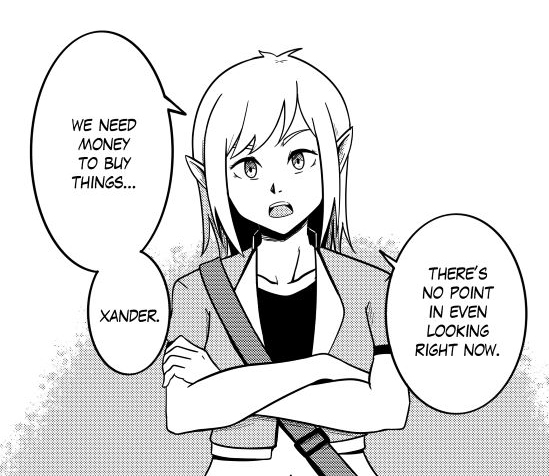
Scroll through Webtoons — which is dominated by heavily manga-inspired offerings — and you’ll see that it’s pervasive. Here’s a page from a webcomic I consulted on recently, LandxSky. Remember, it was originally created in English.
On one hand, we could treat this like slang language. For example, in school you were told that “ain’t” isn’t a word. But it’s used so ubiquitously, that it might as well be. Heck even words that are downright nonsense like “irregardless” have even made their way into dictionaries.
So if an entire generation of creators thinks that this is the way word balloons should look, why bother them.
Three reasons: Communication, composition and phrasing
First of all, word balloons are incredibly powerful. A well-designed word balloon can convey an entire spectrum of emotions. For example, we can use that extra space inside a word balloon to indicate a whisper. And a well-balanced word-balloon is conducive to a clean, easy reading experience. That’s crucial. If your comic is challenging to read, people are going to avoid it.
Secondly, a word balloon that wastes that amount of visual space is having a negative effect on your panel composition. In other words, a panel is a finite space, and we, as comics creators, are trying to use that space as efficiently and effectively to balance words, images and other intangibles to construct a pleasant reading experience. Simply put — we don’t have the luxury of wasted space.
Finally: phrasing. Cramming horizontal sentences into a vertical structure makes good phrasing nearly impossible. For example, take the example to the right. It reads like this:
WE NEED
MONEY
TO BUY
THINGS.
However, that’s not how that sentence should be phrased. And a good word balloon should guide that phrasing. It would read much better like this:
WE NEED MONEY
TO BUY THINGS.
…but that requires a more horizontal word balloon.
Functional word balloons
In 1896, architect Louis Sullivan became famous for the phrase “form follows function.” He insisted that a skyscraper’s exterior design should reflect the different interior functions.
Word balloons are no different. Their form should reflect the structure of the words they’re designed to present.
Cartoonists Dave Kellett and Brad Guigar give some advice to a cartoonist whose friends want his comics for free. Is this an entitlement issue? It is… but not in the way he thinks.
ON THIS WEEK’S SHOW…
My friends won’t buy my comics!
UPDATE: dinokickstarter.com
UPDATE: A rolling stone does NOT gather moss
UPDATE: “Brad Guigar Stole My Woman”
Presenting an archive of older work
Dream goals.
Today is a great time to bump up your ComicLab membership to the $10 tier! Patreon backers at that level will get exclusive access to livestream recording sessions — as well as an archive of previous livestreams!
Writing comedy is a challenge that is made even more daunting in the fact that humor itself is completely subjective and impossible to define. Here’s some thoughts on taking a clever idea and pushing it until it’s actually funny.
The content you are trying to access is only available to members.
I took a question on Twitter recently: “Would it be wrong to draw my comics on A4 paper? I find it hard to fill big spaces.” My answer was, of course. that he should do what they felt comfortable doing. 140 characters doesn’t leave a whole lot of room for art advice. But it made me think that perhaps some news artists might not appreciate a basic rule of drawing…
The content you are trying to access is only available to members.
Unnecessary tangents in an illustration can be distracting — and kill the composition in an otherwise great drawing. While sketching a page for his Evil Inc comic, cartoonist Brad Guigar discusses tangents and how to avoid them.
The content you are trying to access is only available to members.
It can be frustrating to “hit the wall” in your creative output, but — speaking from experience — that wall isn’t a wall. And once you realize what’s actually happening, you’ll feel a lot better about your journey as an artist.
We often feel exhilaration as creative people. When our brains are storming, when our synapses are firing, and when our output is exciting… these are the moments we live for!
But it’s not a constant. Sometimes, the creativity comes much slower. During those times, it feels as if we’re not progressing. And the excitement that comes from finding something new is a long-distant memory.
If you talk to many artists during those times, they’ll tell you that their creativity has “hit the wall.”
But, speaking from a position of experience and perspective, I can assure you that this is not the case. In fact, what you’re experiencing is not a wall, but rather, it’s a plateau. It feels as if you’ve come to a full stop because you’ve stopped experiencing that exhilarating upwards “whoosh” of creativity. But, in fact, you are now on a horizontal plane.
That’s an important distinction. You can move forward on a horizontal plane. It may not be as thrilling as a vertical “whoosh,” but it’s important that you move forward nonetheless.
After all, this is where you’re learning about yourself as an artist. This is where you build speed. And muscle memory. This is where you master all of those things that became apparent during your last explosion of creative energy.
Besides, moving forward is the only way to get to the next “whoosh” of creativity. And trust me, the burst of artistic energy that occurs after a long plateau is a satisfying experience indeed.
Don’t get frustrated about “hitting the wall.” See it for what it is — a preparation for the next big explosion of creativity.
Jumpstarting creativity
Here are some excellent strategies for getting your brain working again after you feel as if you’ve hit a wall:
PUT PENCIL TO PAPER
For many of us, creativity is intrinsically linked to the act of making marks — writing and/or drawing. When I look back on the times when I felt my creativity had stalled, there’s a common thread — I was unable (or unwilling) to start the physical process.
So snap out of it. If you’re trying to write, start a sentence. Or re-start the sentence that you’re working on a difference way. Use different words or put them in another character’s mouth.
If you haven’t even gotten that far, don’t underestimate the power of idle doodling. Start a sketch and follow it where it goes. Fill your page (or several pages) with nonsense, free-associative sketches. It’s amazing how much inspiration comes springing out of this process.
CHANGE YOUR PROCESS
If you write in one particular setting, find a new place. For example, if you write at home, go to the park — or a coffeeshop. If you write during the day, switch it up and write at night. But be careful: Make sure you’re still actively pursuing the writing process and not simply avoiding it. In other words, a trip to Starbucks can inspire your writing — but only if you actively try to write while you’re there. If you spend the entire time chatting up the barista or simply staring out the window, you’re doing more avoidance than actual writing.
DO SOMETHING MINDLESS
Clean your room. Fold the laundry. Rake the leaves.
But do these things without the usual headphones or background noise.
Allow yourself to do these things in total quiet. Once your hands are busy, your mind will wander.
GET BORED
I love it when my kids tell me that they’re bored. Because necessity may be the mother of invention, but boredom is the father of creativity.
So let yourself get good and bored. Turn off the music. Unplug the TV.
Oh, and get far, far away from anything that will deliver you the Internet.
Remove all the distractions and then get beautifully bored.
Your mind will find something to do. All you have to do is direct it.
GIVE UP
If you’ve spun your wheels for an hour or so — and I mean really, really tried to get some creativity happening — give up. For now. Do something else that makes productive use of your time. For me, that often means pencilling some of the strips I’ve already written. Or do something that needs to be addressed for your business (are your receipts organized and filed so you can find them during tax season?). Or make that improvement to your Web site that you’ve been putting off. Just make it a point to come back to writing at your first opportunity and try again.
EXERSIZE
Get your heart rate up and keep it up. Get a good, long, tiring workout in. And then, once your body is good and exhausted, sit yourself down and write.
SUGAR AND/OR CAFFEINE
Not a health nut? Stop by Dunkin Donuts and pick up a large coffee and a donut. The resulting buzz can propel you into a little chemical-induced creativity.
Before you take this as a license to write off bad eating habits as the cost of doing business, keep this in mind: This works best when the sugar/caffeine comes as a jolt to your system. If a coffee and a donut is part of your routine breakfast, it’s hardly going to be a jolt.




 Loading ...