Webcomics.com Poll: Promotion
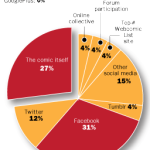
Last month, we asked what you felt your strongest promotional tool was.
You answers were both predictable and surprising
The content you are trying to access is only available to members.
Last month, we asked what you felt your strongest promotional tool was.
You answers were both predictable and surprising
The content you are trying to access is only available to members.
While I was attending Special Edition: NYC last weekend, I talked to a lot of creators about the Big One — Comic-Con International in San Diego — which is only a few weeks away.
And I heard from more than one artist that — much like Marvel/Disney, who announced a pull-out earlier in the year — they were either pulling the plug this year or that this would likely be their last year exhibiting at the convention.
And all of the stories lined up along the same axis: Profit. (Or lack thereof.)
The content you are trying to access is only available to members.
This post originally appeared on the Evil Inc blog.
When Emerald City Comicon announced that it was merging with ReedPop, everyone who knows and loves the Seattle-based convention had the same question:
“Will ReedPop change Emerald City Comicon?”
I mean, after all, exhibitors and attendees alike have loved this show — run by Jim Demonakos and an amazing staff of dedicated comics-lovers — for years.
Ask anyone who has ever exhibited there. and they’ll tell you that they’ve never been treated better. Ask the attendees. They’ll tell you the show is a highlight in their year. This show was special. And there’s more than a few people who felt a little worried that this Good Thing had come to an end earlier this year when the merger was announced.
Scott, Cory and I wondered it on a recent episode of Surviving Creativity. We got both Jim and ReedPop VP Lance Festerman on the line to assuage our fears.
They told us that Emerald City was going to continue unchanged.
We crossed our fingers and hoped for the best.
So imagine my surprise — my downright elation — when I walked into the ReedPop-run Special Edition; NYC convention this weekend. This was the first Reed show since incorporating the Emerald City staff, and it was — for all intents and purposes — Emerald City East.
The content you are trying to access is only available to members.
I started my Patreon campaign in April 2014 at about $100/month. Over the next six months, it had risen to about $400/month, and it flatlined there for the next seven months.
In May 2015, I announced NSFW comics for backers at the $10 level and higher. By the end of the month, my total had risen to about $1,200/month — almost tripling the previous month’s total!
And, almost every day since, I’ve added at least a couple backers.
How did I find myself doing NSFW comics for my Patreon backers? Let’s start at the beginning.
The content you are trying to access is only available to members.
You don’t need a subscription to read today’s post!
This post originally ran Sept. 2013. If you’ve ever been curious about the kind of information, tutorials and advice that you’ll get as part of your subscription to Webcomics.com, this is a good example.
If you’d like to join the site, you can get a 12-month subscription for $30 — or you can get a one-month Trial for $5 … with no obligation after your 30 days expire. For less than three bucks a month, you can get a steady flow of information, tutorials and advice targeted towards your webcomic business — plus a private forum to discuss issues with other professionally minded cartoonists.
When I saw this, earlier in the week…
Some dickhead snuck into my friend’s booth during Awesome Con and made off with her cash box. It was mid-day Sunday so they got everything.
— Rafer Roberts (@plasticfarm) June 1, 2015
The cop who took April’s statement said that a bunch of folks had gotten robbed during the show. He’d been taking statements all day. — Rafer Roberts (@plasticfarm) June 1, 2015
… I knew what I’d post for the next subscription-free Archive Dive. It’s this post from Sept. 2013 that shares some important safety advice for exhibiting at conventions.
I was exhibiting in Artist’s Alley at Baltimore Comic Con this weekend. Sometime Sunday afternoon, my neighbor, a novelist who was working one of his first comic conventions, suddenly made the realization that his money bag — containing his entire revenue for the weekend, had been stolen. He had set the bag on the table as he was making change for a customer, and, after trying to make change for the next customer, realized that the bag had been lifted.
We tend to get so caught-up in the camaraderie and fellowship of a comic convention that we tend to forget that there are always a few bad apples in every bunch.
So I thought this might be a good pace to assemble some tips for preventing convention theft. I’ll start with a few of my own. Feel free to add to the list.
Nobody puts their stuff on the table. Ever
This is just a good rule of thumb.
Never put your money box (or bag) on the table. Keep it on a chair next to you or (better yet) under the table. Make change out of arm’s reach.
If you put it on the table, it’s a simply matter for an unscrupulous attendee to set his or her belongings (a book, for example) on top of the money and then pick them both up (using his book to shield the money from your line of sight).
This is actually a good reinforcement for another convention strategy that you should get into — sales inventory. I know several people that I exhibit with who do this. They make a grid with the names of all of their merchandise going down the left-hand side. And they track the sales of these items with a simple hash mark. By affixing this inventory sheet on the money bag (or inside the lid of the money box) — and getting into the habit of marking every sale — they have an increased probability to notice that it’s missing sooner.
This is simply a good practice to get into in general. from the guy who sets a sweaty drink on your original art to the scum who tries to pull one of these…
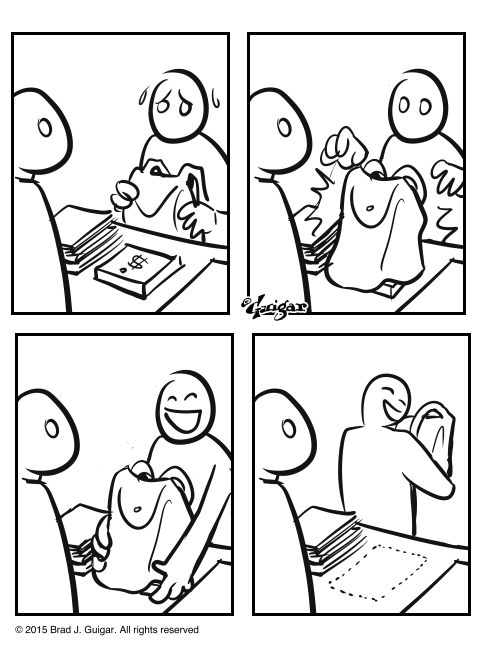
The rule is simple: No one puts stuff on your table. ever.
Never keep all of your money in one place. The money box should be for collecting that day’s revenue and making change. You should have an alternate (and safe) recepticle for the money you’ve made throughout the weekend. During a lull, inconspicuously transfer some of the large bills from your money box to this secondary repository. (But always leave yourself enough $20s to make change for a $100 bill.) That would have made the difference between a nasty theft and one that wipes out you entire weekend.
We’ve discussed this before, but it bears repeating: If you use an iPad (or other digital tabled) to process sales, be sure to lock it down.
We put so much emphasis on creating vertical displays and maximizing table space that we don’t realize that we could be creating areas on our tables that we can’t see. And if we can’t see what’s going on there, it’s the perfect place for someone to swipe something off the table.
I only use the hotel safe in the case of a (1) long convention and/or (2) significant amount of cash. Your money should be secure in the hotel safe. Just remember to take it out before check-out. Phil Foglio once shared a nightmarish story about being on the plane to leave San Diego and remembering that he had left all of the money he had earned through the previous week in the safe at the hotel. As the plane prepared to taxi down the runway, he was on the phone to the hotel trying to frantically explain the sutuation and see if he could rely on the honesty of his fellow human beings. Needless to say, they reported no money found in the hotel safe.
At the end of the day, take everything off the table and stash it underneath. If you can’t remove it, cover it with a sheet or a blanket. Why? Because most acts of theft in threse situations aren’t pre-meditated. Rather, they’re the result of people succumbing to temptation. Take away the temptation, and you’ll be able to twart a large amount of potential theft.
Obviously, it’s great to have people you trust helping you behind the table. And those extra pairs of eyes are a great benefit in watching for potential wrongdoings. But unless you’ve welcomed someone behind the table, you are well within your rights to eject them from your personal space.
At the start of a convention, as I’m introducing myself to neighbors, I tell them who (if anybody) will be helping me behind my table. And I ask about their staffing situation as well. That way, we all know who is allowed behind the tables — and who’s not. If an un-introduced someone steps behind my neighbor’s table, I’m well within my rights to address them and ask them to step away. If it’s a misunderstanding, it’s easily explained. But if I’m right, I just saved my neighbor his or her livelihood.
Usually, this is a small-convention problem. There’s either a very open floor plan or there’s a lot of space between the tables. It happened to me at ConnectiCon one year, when a cheery anime fan decided to pop behind my table and start drawing in my sketchbook because she thought I “looked lonely.”
But it can be a problem at larger shows, too. I saw it happen this weekend in Baltmore. Their Artists’ Alley plan had the endcap tables moved out from the aisles on either side. This was nice because it gave Artists’ Alley exhibitors an easy entrance/exit point. However, that also created space for a fan to step into (in an attempt to get even close to the creator, I guess). And that’s a dangerous invasion of personal space.
It’s time to kick off another round of Hot Seat critiques. This is a unique opportunity for us to get down-and-dirty with the craft of comics — and some of the best practices of business, marketing, social media and more.
This time, we’re focusing on an integral part of comics — lettering and word balloons. The rules are simple: I go to your site and point of one thing you’re doing well, and one thing that might stand some improvement.
The content you are trying to access is only available to members.
One of my (few) complaints about Patreon is that there’s no analytics built into the creator-side dashboard. I’d like to be able to track pledges over time, see declined pledges, project monthly earnings, etc.
Although Patreon hasn’t built in this functionality, one clever person has — and made it available to the public.
The content you are trying to access is only available to members.
Now, more than ever, it’s easy to see what a subscription to Webcomics.com will get you.
Every Friday, you can read the entire Archive Dive post without a subscription. This is a post from the site’s archive that I pull out front again because it still has relevant information you can use today. This is especially nice for newer subscribers (or anyone else) who may have missed it when it originally ran.
Plus, at the beginning of every month, I do a wrap-up that highlights some of the best posts — from the site as well as the private forum — from the preceding month.
If you’re curious about joining, we’ve made it easier than ever with a $5 trial membership. You’ll get full access to the site for thirty days so you can see what you’ve been missing. At the end of the trial, you can choose to re-subscribe ($30 for 12 months of access) or walk away with no strings attached. You will not be re-billed unless you choose to subscribe.
Please note: The links below will lead you to content that is “subscription-only” content. Why do I do this? Simple. If you see something that intrigues you and decide to subscribe, you can come back here and use this post to jump right to the post that caught your attention. And once you do that, use the other Best Of posts to drill even deeper into the site!
Best of the siteWebcomics.com Poll: This month saw the return of the Webcomics.com Poll. The topic was revenue streams, and the big surprise wasn’t No. 1 (Advertising), it was No. 2.
The Art Institute closed several campuses across the U.S. We gave members the heads-up on possible student-load breaks.
In another installment of Inside the Cartoonist’s Studio, Jules Faulkner shared a look at her workspace. This feature is open to any members who would like to share a look at their studio space.
The NoFollow link: What it is, and why/when you should use it.
Using GMail’s Canned Responses to increase productivity.
We opened a new Hot Seat critique series — this one focusing on lettering.
House ads over the comic. Comic Easel and ComicsPress make it easy to include a potent reader-outreach with out comic updates, yet many of us don’t use it. Here’s how to get the most out of this approach.
Copyright and profitability — “It’s not copyright infringement if I’m not making money, right?” Wrong. And here’s why.
Self-Promotion: It’s incredibly effective… the problem is that most of us are doing it wrong.
Syncing Manga Studio between two computers — a quick tutorial.
Too many directories? One member received an e-mail saying that his site had too many directories. We were able to alert the member to the fact that this was not an email from his Web host — rather, it was a phishing scam.
Keeping up with modern monitors
Making an interesting exposition page
Kickstarter deals for Patreon supporters?
Finding the best lettering size
Two of the of the strengths of Manga Studio is the ability to create page/strip templates and save image “material” to use again later.
But what if you use the software on two different computers — for example, one in your studio and another at home?
Relax. There’s an easy way to sync everything up.
The content you are trying to access is only available to members.