The two award categories for the Cartoonist Studio Prize are Print Comic of the Year and Web Comic of the Year.Finalists for each category will be announced in early March. The two winning comics will be announced in early April.
Eligible print comics must be written in (or translated into) English and published between Jan. 1 and Dec. 31 of 2018. Creators or publishers may submit a print comic for consideration by clicking here.
Eligible web comics must be written in (or translated into) English and published online between Jan. 1 and Dec. 31 of 2018. Creators or publishers may submit a web comic for consideration by clicking here.
Submissions in both categories must be received by January 31, 2019.Currently enrolled CCS students and faculty are not eligible for the award. Creators may submit one—and no more than one—work in each of the two categories. The judging panel reserves the right to consider work that was not officially submitted.Creators or publishers may submit a work for consideration by sending a physical copy of the book, along with a submission form, to:
The Center for Cartoon Studies
Cartoonist Studio Prize
PO Box 125
94 South Main Street (Fed Ex and UPS only)
White River Junction, Vermont 05001
SUBMISSION FORMS
Printed comic creators or publishers may submit a comic for consideration, click here.
Eligible Web Comics must be written in (or translated into) English, published online between January 1 and December 31 of the previous calendar year. Creators or publishers may submit a web comic for consideration by clicking here for the online Web Comics form.
Submissions in both categories must be received by January 31, 2019.No creator may submit more than one work in either category. The judging panel reserves the right to consider work that was not officially submitted.Questions?
studioprize@cartoonstudies.org
When a patron discontinues his or her pledge, they are offered an exit interview. This gives them a chance to explain why they’re leaving.
I’ve found this to be the classic good news / bad news situation. Here’s why:
“It’s not you — it’s me.”
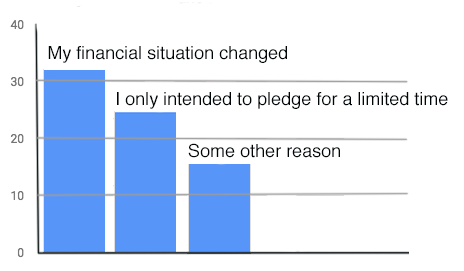
Patreon has long told us that the primary factor in a patron ending a pledge is that their financial situation has changed. And the statistics back this up pretty clearly. Just glancing down the page, makes it clear that an ended pledge is more about the patron than it is about the content being offered. (And, yes, I realize that this assumes that the ex-patron is telling the truth.)
The second-most-popular answer: I only intended to pledge for a limited time. That backs up a philosophy we’ve discussed here in the past. Many Patreon backers do not view their pledge as a long-term commitment. That’s important to note as you’re developing your rewards. If you’re setting up rewards that pay out over a long period of time, you may be missing a significant portion of pledgers who don’t plan to stick with you for that long.
Here’s how my responses (Since September) broke down:
So… the good news is this: You can stop beating yourself up over lost backers. Most of them have dropped out for reasons that have nothing to do with your content. And the others had a pre-determined time frame in mind when they joined. And your content did little to change that.
Give it the proper weight
Perhaps the most-offered advice on the Internet is “Don’t read the comments.” It’s simple, the perceived anonymity of the Web emboldens people to write things that they’d never say to another person’s face. It’s for that reason that I’ve posted several pieces (like this one) that try to help properly walk the balance between gauging reader feedback and being creatively paralyzed by it.
The Feedback column in the Patreon Exit Interview has the potential to be just as frustrating as reader comments.
But the more dangerous area, by far, lies in getting to emotionally invested in these comments. I found myself obsessing over a single negative comment. The amount of brain space I devoted to it was — honestly? — depressing. What’s worse is this: Most of the comments in the feedback section were positive. But me, I couldn’t see those because I was too focused on the negative ones.
Now, as I’ve said before, you can’t afford to disregard comments from Patreon backers completely. In fact, I’ve argued that their comments should be taken much more seriously than run-of-the-mill reader comments. So, do take some time to read and reflect on the comments you’re getting there.
Award season is upon us. Although I’ll be featuring a post with the details of each as it is announced, here’s a look at some of the awards you may want to start preparing for. For more information on any of these awards, feel free to use the Search function on this site to look up nomination/submission instructions from past years. They’re usually the same from year to year (except for the deadline dates, of course).
The content you are trying to access is only available to members.
BUT FIRST, Dave marvels over the exercise craze of the belt vibrator. And that leads to this little-known story about the true-life origin of Marvel supervillain, the Shocker.
Show notes
00:00 — The belt vibrator
08:10 — Understanding “sharing statements” in social media
27:05 — Sharing on Instagram
47:50 — We use the passing of Stan Lee to get Kevin to do his Fake Stan Lee impression
55:48 — Possible replacements for Tumblr for web hosting
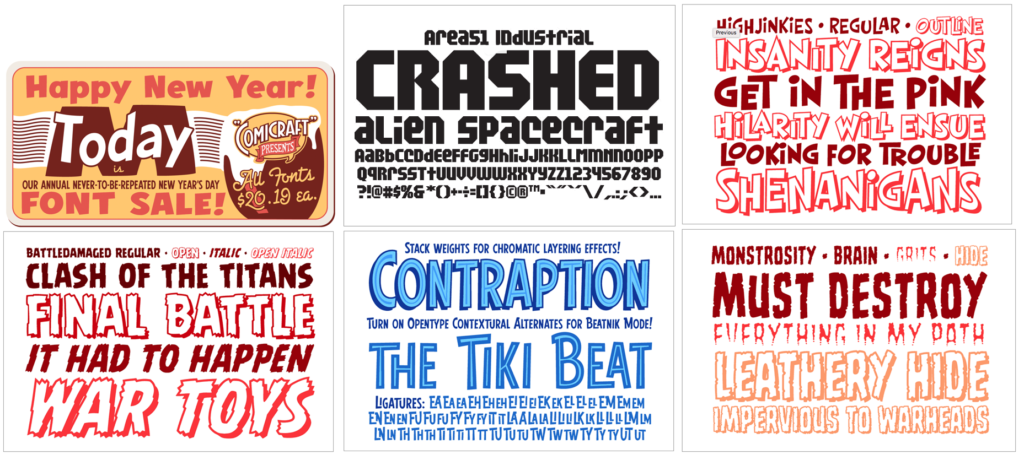
As you’re clearing your heads from last night’s festivities don’t forget the Comicraft sale today. It’s an excellent time to stock up on fonts you’ll use for years to come. Here’s what I snagged this year…
If you want to build out your comics-font library, be sure to mark this on your calendar. ComicCraft traditionally holds a sale on Jan 1 every year in which price of each of their fonts is based on the year. This New Year’s Day every ComiCraft font will be $20.19 apiece.
The content you are trying to access is only available to members.
When I worked in newspapers, December always meant end-of-the-year lists. Every writer in every department would file one. Why? Well, I guess they can be pretty interesting. But more importantly, they’re easy content to churn out during the busy holiday season.
So let’s discuss a quick-and-easy way to generate a top-10 list for your comic.
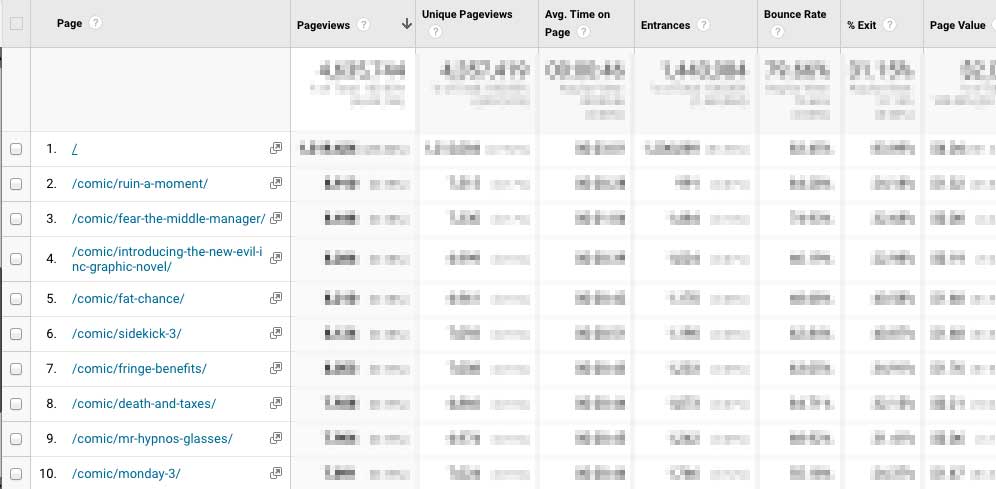
Google Analytics — Pageviews
First, we’re going to use Google Analytics to discover the top 10 most popular comics in our archive.
Change the time frame to Jan. 1, 2016 – (today’s date)
Click on Behavior in the left-hand column
Now click Site Content, and then All Pages
This will generate a list of the most popular pages in your archive, by pageviews.
Your home page, obviously, is going to be the most popular, but let’s leave that out of it. The next page down will be the most popular archive page, and then the one after that will be second-most popular, and so forth.
Google Analytics — Organic Search
Alternately, you can build your list based on organic search results.
Change the time frame to Jan. 1, 2016 – (today’s date)
Under Audience / Overview, click Add Segment (at the top)
Select Organic Traffic from the list and click Apply
Go back to the top of the page, Select All Users (by clicking the downward-facing arrow) and click Remove.
Go to the left-hand column and open Behavior
Under Site Content, click Landing Pages
Now you have this year’s most popular pages, in terms of search results.
Build your list — quick
Remember… the name of the game is to get this done quick so you can get back to spending time with your family over the holidays. If you’re using ComicPress or Comic Easel, it’s gonna be a snap with shortcodes.
In this case, the shortcode you’re looking for is [[randcomic slug=SLUG]]
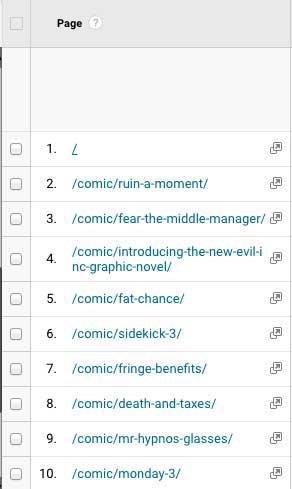
Just replace “SLUG” with the slug of the post — which is that hyphenated phrase after /comic/ in your Analytics list! So, using the example above, my #1 comic is short-coded as [[randcomic slug=ruin-a-moment]]
Top 10
My preference is to start with the tenth-most-popular comic and work my way backwards to the most popular. (You’ll have to load the next ten results to see the actual #10 — since you won’t be including your home page).
I assemble them into a list, making a brief comment about each, and — presto! — I have a quick-and-easy Year-End Top 10 list!
















 Loading ...