One of the smartest things you can do as your webcomic starts to transition from hobby to business is to establish a new bank account for your burgeoning venture. Keeping comics finances separate from your household income has several benefits. Here’s what you need to know…
The content you are trying to access is only available to members.
Today we’re going to talk about a sentence that every last one of us have uttered:
I really feel like if I could get more people to see the comic they would actually like it…
There’s not a webcartoonist alive who doesn’t feel that way. Heck, I would imagine it applies to any creative profession. It’s one of our very few Universal Sentiments.
But it’s a mindset that misses an important point, and until you understand it, I think it’s going to hold you back.
What I think you’re missing is this: You’re already getting new readers. Every day. The question you should be asking yourself is whether you’re keeping the new readers you do get. And if that answer is no, you have to take a long, hard, objective look at why that is. If you think your comic is good — and if you’re not keeping new readers — then maybe it’s not as good as you think it is.
Quality is #1
Think about it. Every day you’re getting new readers. If they like your comic, they’ll become regular readers. If they don’t like your comic, they won’t.
Let’s do a thought experiment.
Let’s say I gave you a magic wand. With one wave of the wand, you could get a million people to view your site on one given day. On that day — poof! — a million potential readers. If that comic’s not good enough, how many of them are going to stay? How many of them will come back tomorrow? Conventional Wisdom tells us that you’ll get a decent percentage — but for how long? If that next update isn’t very good, you’re going to lose some of those. And unless you’re able to Bring It — with frequency, consistency and significant — on a regular basis, you will have lost most (if not all) of those million in the span of a few months.
Now, what would you say if I told you that you already have that magic wand?
It’s called your Web site. And although it’s not going to deliver that million new readers on one single day, it will deliver them over the course of the next year or two. If you’ve been publishing for a while, it probably already has delivered that many. Maybe more.
Have you kept them? If not… is it the wand’s fault?
I can’t tell you if your comic is good or not… but your traffic will give you some clues. Look at your update days. A high ratio of new visitors coupled with a high bounce rate tells you that you brought new people in the door, and they didn’t find anything there to encourage them to read any further.
And you have to compare both stats. For example, if you have a high ratio of return visitors — coupled with a high bounce rate — that’s an indication that those readers aren’t diving into the archive because they’ve already read that content.
Everything after the quality of the comic itself is secondary. But the two top secondary concerns are Web-site retention and social media.
Web-site retention
Take a moment and look at your site from the perspective of a first-time visitor. Now ask yourself:
Does your Web site retain readers?
Does your site load quickly?
Are you encouraging financial support in the form of sales, Patreon, and so forth?
Do you promote archive storylines?
Do you make it easy to navigate into the archive?
Can new readers find archived material based on their own interests?
Can a new reader easily figure out the concept behind your comic in an About page?
Does your site make it clear that there’s more going on than just that one comic they see?
Does your site make it clear that there are other ways to enjoy your content — books, eBooks, etc.?
In other words, what are you doing to make sure your new readers will come back tomorrow — or at least stick around for a little while longer and become increasingly interested in what you’re doing.
Social media
Now more than ever, reading habits are changing on the Web. That makes social-media outreach on the Web super-important. Readers rely less on bookmarks and RSS feeds — and more on social-media alerts. It’s just something we can’t ignore. I offer tons and tons and tons of tutorials and advice on this site to help members do their social media outreach better.
But as important as it is to have a healthy social-media presence, it’s absolutely crucial to make it easy for people to use social media to tell their friends about your comic. That’s why I always advocate having “share” buttons under the comic. Having buttons on your site that lead to your social-media pages isn’t nearly as important as having buttons on your site that enable readers to share your work.
If you’re not doing this, I think you’re making a very big mistake.
The rest?
Message boards are becoming less and less important (from a promotions standpoint) and paid advertising…? You have to put an awful lot of time and energy into making this a worthwhile investment of time and energy. Otherwise, it’s a gamble. Now that we’ve passed the tipping point in the use of ad blockers, it’s a complete waste of time and energy.
No easy answers
And that’s just the problem. It’s not a question of installing one simple plug-in on your site. And it’s not a question of improving a single punchline or story beat. It’s doing all of that — plus social media, plus a whole lot more — and doing it tomorrow, too, and the day after that… It’s an ongoing struggle. Next chance you get, ask a creative pro who you think has “made it,” and ask him or her what they did to get to that point.
Nine-chances-out-of-ten, they’ll tell you that they’ll let you know as soon as they get there.
Washington, DC (September 11, 2019): The Graphic Artists Guild thanks the House Judiciary Committee for passing HR 2426, The CASE Act Amendment in Nature of a Substitute, out of committee by voice vote with no dissensions. The small copyright claims tribunal proposed by The CASE Act is a voluntary, affordable, expedited option that is balanced and fair to both copyright holders and copyright users.
The bill has already passed the Senate, so now it moves forward to be voted on by both chambers. According to Billboard.com, “Industry sources say they are hopeful it will come to a full vote in both legislative arms before the October recess.” Also from Billboard:
“The legislation would create the Copyright Claims Board at the U.S. Copyright office, who would hear and rule on small claims cases of copyright infringement where damages would be capped at $15,000 per claim and $30,000 in total, which means that smaller independents can file claims without taking on the added expense of an attorney.”
“The CASE Act’s goal is to make it simple and fast for copyright holders to get paid for infringement claims. The method it employs is to create a quasi-judicial body in the Copyright Office called the “Copyright Claims Board,” which would be able to award damages as high as $30,000 per proceeding, while also strictly limiting the ability of parties to appeal the decisions. $30,000 judgments issued by people who are not judges but rather officers of the Copyright Office, who see copyright holders—not the general public—as their customers, are not “small claims”. These are judgments that could ruin the lives of regular people; people who are engaging in the things we all do when we’re online: sharing memes, sharing videos, and downloading images.”
If you pay estimated income taxes on a quarterly schedule, Monday’s the deadline for your third-quarter payment. Checks postmarked with Sept. 16, 2018 will be considered paid on that date, according to irs.gov. You may also pay online, pay by phone, or use the IRS2GO app.
This episode of ComicLab is sponsored by Wacom! In this week’s show, the guys discuss all of the lessons Dave learned on his trip to Disneyland — from cool-hunting pins to branding emotions. Then a question-asker asks about the best way to transition social-media accounts. Next, Dave talks about launching his new Kickstarter. And finally, the guys talk about the “Good Ol’ Days” of Webcomics — and what they’d like to bring back.
BUT FIRST… Brad explains to his college students why everyone loves Snow White so much.
QUESTIONS ASKED…
Dave talks about how Disney branded happiness
The Enchanted — and problematic — Tiki Room
Cool-hunting Disney pins
Garfield originals are being auctioned off by Heritage Auctions
Dave discovers you can change your Wacom pen nib
Transitioning social-media accounts
Dave launches a new Kickstarter
Which part of the “Good Ol’ Days” would you bring back?
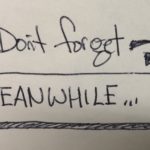
It seems like it happens every time I’m stuck in writing a storyline, I keep forgetting my ace in the hole. It happens so often that I have a standing page in my sketchbook that I’ve marked for writing emergencies. It has a single three-word sentence of advice that has ye to let me down…
The content you are trying to access is only available to members.
This episode of ComicLab is sponsored by Wacom! In this week’s show, the guys discuss tips and strategies to improve your humor writing. Then, a question-asker asks if it’s OK to re-use backgrounds. Next, it’s advice on doing a comic convention when you have a speech impediment. Also, when will self-publishing become acceptable in other media — such as kids’ lit, sci-fi, novels, etc.? And finally, Brad explains romance novels to Dave.
But first… Brad’s wife came home to find a dog asleep on the sofa.
They don’t have a dog.
QUESTIONS ASKED…
Dave talks about his love for the Wacom swing arm
How do you find the Funny?
Is it OK to reuse background illustrations?
How do you do comic conventions when you have a speech impediment?
When will self-publishing become acceptable in kids’ lit, sci-fi, novels, etc.?
Brad explains romance novels to Dave
Brad explains audio erotica to Dave
Dave has enough
Brad Guigar is the creator of Evil Inc and the editor of Webcomics.com Dave Kellett is the creator of Sheldon and Drive.
“Patreon, the subscription-based fan platform, is eyeing a range of new services to support creators — including potentially providing loans at some point, CEO Jack Conte said.
“Conte, speaking at Variety’s Entertainment & Technology Summit in L.A., said Patreon is considering ways to provide capital funding and other financial services to artists, as well as services like health insurance and HR support.
“‘Nobody’s building for creators right now,’ Conte said. ‘Even [platforms] that say they’re building for creators aren’t — advertisers are their customers.’
“’It’s so hard for creators to get a loan,’ said Conte. He talked about his difficulty getting a home loan when he was an indie musician in the band Pomplamoose with his wife, Nataly Dawn. The lender wanted to see Conte’s pay stubs; ‘I sent my iTunes sales reports to the bank,’ he said.”
The content you are trying to access is only available to members.
Set down the sunblock, and step away from the pool. It’s time to start planning for December and January.
I know it’s hard to get into the spirit, but this is the time to start working on merchandise for the holiday shopping season. In recent years, webcartoonists have offered an increasing compliment of holiday goodies that have ranged from specialty T-shirts and mugs to holiday-themed greeting cards. And let’s not forget to add calendars to that list. Those will start appearing in stores by November — at the latest!
So, let’s take a closer look at some of those specialty products, and how we can start working now to be ready to compete when the snow falls.
Calendars
I’ve been pretty dour on calendars as merchandise in the past, and, truth be told, I’m still not a huge proponent of the practice. As I’ve stated before, calendars have a very limited shelf life. Few people buy them after January. That means you either have to have a very strong, dedicated readership to pitch to or you have to go Print-on-Demand (POD) which brings the unit profit way down.
I am a fan of the calendar-creation tool at Lulu.com. (Redbubble.com did awesome calendars. but the demand dropped so low, they discontinued them.) So, as long as I don’t invest too much time on it, I can usually justify putting out a POD calendar.
Sizes
Lulu gives you a choice between two sizes: a large-format calendar that measures 13.5 x 19 inches and a standard-sized one at 11 x 17 inches.
For a step-by-step walkthrough of Lulu’s calendar-creation tool, read this archive post.
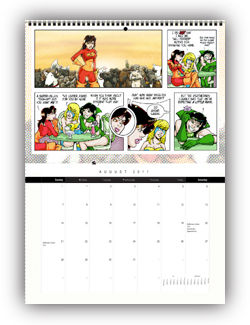
The large-format calendar (like the sample on the right) has a spiral-bound spine at the top, holding sheets of 13.5 x 19 -inch stock.
Add some extras!
Dates: Are you confirmed on any convention appearances for next year? Semi-confirmed? Put it on the calendar! (Just make sure to be clear if any of these are tentative dates.) Other dates to note:
Your birthday
The anniversary of your comic
Any comic-related milestones (500th update, etc.)
Character-related dates
Pricing: Lulu allows you to set your own royalty, but try to keep the final price as close to $20 as possible (for the standard size). $30-range for the larger version.
Buying in bulk
Of course, you could buy a larger number of calendars for yourself, driving the unit cost down, and then try to sell them for a larger profit on your own site. You can do this through your POD vendor or you could invest in an offset print run. However, you risk buying too many and then being stuck with them in January when sales dwindle.
Of course, you can always use them as a loss leader to drive sales to your store later in the month.
September?!
When I released my 2010 calendar, it was November. And, truthfully, I figured this was plenty of time. One of my readers was very upset with me for releasing it so late.
I was perplexed. I couldn’t imagine anyone wanting to purchase a calendar before November, and yet, there was clearly a segment of my readership who had already completed their calendar-shopping for the year — and given the choice, they would have chosen my offering if it had been available.
So, the following year, I offered my calendar in early-October. And my sales were brisk.
But my new recommendation is to release your calendars at the beginning of September! I’ll get into why in a moment.
Conventions
But there’s an even better reason for having your calendar out early: Conventions!
How did I overlook that?!
I brought 20 calendars to New York Comic con one year, and I was sold out either Saturday night or early Sunday. They flew off the table.
Calendars have an edge on the convention table:
Low competition: Not many of your fellow exhibitors will have calendars on their tables (other than your fellow Webcomics.com subscribers). So this merchandise stands out.
Uniqueness: It’s different from the usual book-and-a-T-shirt merchandise you find at conventions.
Early bird: Offering calendars at Autumn conventions means you get a purchase from somebody who says: “Geez, I’m gonna buy a calendar this year anyway… I can cross that off my list now and get something cool and unique.”
If I had those calendars on my table in Baltimore the month before, I’m convinced that I would have made a killing.
Artist Editions
About midway through the convention in New York, one guy who was buying a calendar asked for a sketch inside it — the way I do with books.
How did I overlook that?!?
Thinking on my feet, I asked him what month his birthday fell in. He said “April,” and I flipped the calendar open to that month and did a special sketch, with one of my characters delivering birthday wishes.
Every calendar after that had a special sketch on purchaser’s requested month.
Even if you’re not planning to attend conventions in September, October or November, you should still plan to have your calendars prepped and available by September because if you do, you can order yourself a small stack and offer them on your Web site as Artist Editions.
Most storefront solutions include a way for the purchaser to communicate with the merchant. In PayPal, it’s “NOTE TO MERCHANT.” Advise your readers to indicate the month they want the illustration drawn in — and any birthday messages (if this is a gift for someone else, for instance) — and you’ve got a rock-solid early-Fall merchandise offering.
And your sketches could be simply your characters, or they could deliver birthday wishes, or they could contain references to the person’s astrological sign… the possibilities are endless.
Heck, you could do a very limited number of calendars with sketches on each day and sell it for a premium price.
Holiday cards
A few years back, I launched a couple of Christmas cards and the response was so overwhelming, I vowed to start earlier the following year so I could take advantage of this opportunity better.
Concept
Designing Christmas cards — and let’s note here that the term “Christmas card” is being used as a catch-all phrase for all of the holiday cards that get purchased during the winter holidays — is a lot like designing T-shirts.
No one is going to buy one with your character(s) on them. No one is going to buy them with your strip re-printed on them (unless maybe it’s a single-panel comic).
What they are going to buy are cards that express your unique sense of humor or your identifiable illustration style. It’s perfectly fair game to swipe a punchline from a strip. And it’s perfectly OK if the card has little-or-nothing to do with your comic.
Take the this good advice about designing great T-shirts and apply it to your Christmas card concept.
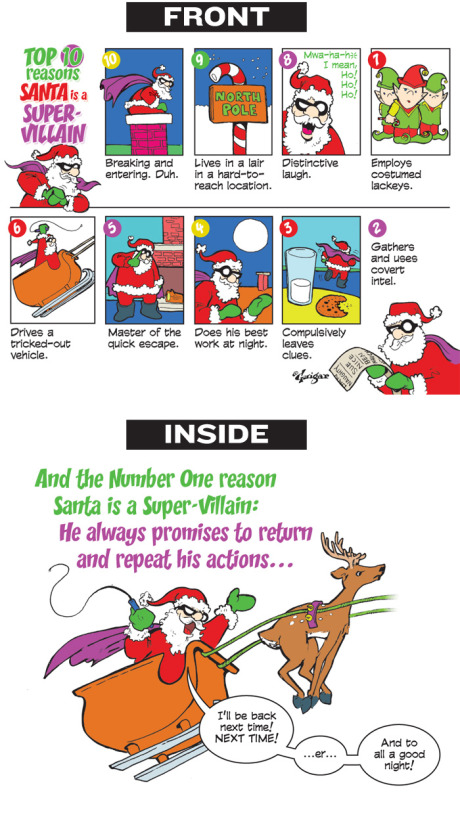
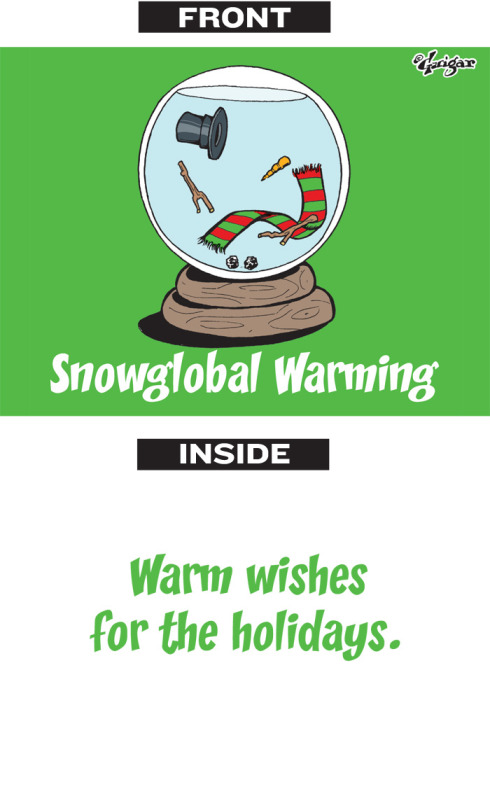
Like I said, I produced two that year. Both are posted a little further down. The first one is related directly to the theme of my comic, but had content that had not appeared in the strip (yet). The second one was completely unrelated to the comic. Both sold well, although the one that matched more closely the “Evil Inc” theme sold a little bit better.
When you think about it, designing a greeting card is very similar to creating a two-panel comic. The cover is the first panel and the inside can be the second panel.
In fact, it’s an incredibly effective two-panel comic because it’s impossible to look ahead to the punchline and ruin the build-up. You can build a nice amount of suspense that will charge the pay-off nicely. For example…
Of course, you can also approach it as a single-panel comic — with a nice, themed message on the inside.
Printing
The usual online printers are already offering specials for people printing greeting cards for the holidays. PSPrint has offered as much as 60%-off. Overnight Prints has offered 50%-off on holiday-related printing.
Make sure appropriately-sized envelopes come with the order. If not, buy some, and factor that expense in to your final price.
Shipping
Remember, you’re shipping off someone’s greeting cards. They need to arrive in good shape. I bought these cardboard boxes from Uline last year, and they performed beautifully.
Welcome to September, and the kids are headed back to school. If you’re a parent, that probably means that the time you’re able to devote to comics just tripled. Let’s talk about using it wisely.
The content you are trying to access is only available to members.










 Loading ...