Patreon will now give you your earnings in advance — for a small price. It’s called Patreon Capital, and it’s actually a cash advance against future earnings. Some artists are comparing this to predatory “payday loans” and others are conjuring scenarios in which artists use these funds to cover medical expenses. Given what we know, neither of these interpretations are very accurate. So let’s take a look at what’s actually happening, and see if we can reach a more reasonable understanding.
The content you are trying to access is only available to members.
I attended the Patreon On Tour conference in New York City, and I strongly advise you to take advantage of this opportunity if it comes to a city near you. It was packed with great data-backed information, like information on which Patreon rewards work best.
At one time in the presentation, the topic of promotion came up, and the data they had gathered floored me. I’d been thinking about patron-acquisition all wrong. Here’s what I learned…
It’s Not All About Social Media
According to their research, about 40% of new Patreon backers arrive through social media — less than half!
Think about it. If you’re focusing on social media to spread the news about your Patreon rewards, you’re missing sixty percent of the other avenues! Here are the other ways patrons find out about the Patreon campaigns they back:
The creator’s website itself
Fan forums
Newsletter / e-mail marketing
Press
Events (conventions, etc.)
Paid advertising
Collaborations
Phone calls
Let’s talk about a few of those…
Website
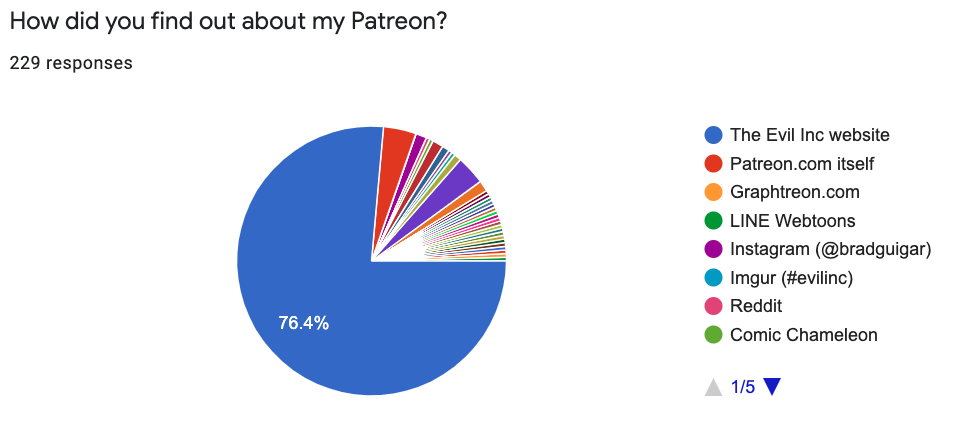
I surveyed my backers, asking them one question: How did you find out about my Patreon? More than 70% said they found out through my website. I’ve added the survey to my standard Welcome package when a new backer joins, and the percentage has only risen. It’s now 76%.
Although you can’t count out social media entirely — after all, perhaps those readers found my site through social media — it’s a stark reminder of the power your website still wields.
House ads
If you’re like many of us, you’ve seen your advertising revenue decimated by ad blockers. You may have even removed advertising from your site entirely. But that space is still has value — even if it’s not currently delivering on that value. House ads have long been promoted on this site as a way to bolster that undervaluation. The application to this instance is simple: Replace the paid-advertising space with self-promotion space. If you code it directly into the page, you can even bypass ad blockers. There’s no better place than your site to find the people that are most likely to back your Patreon campaign. Use that old advertising space for outreach.
Collaborations
This is a great way to promote a Patreon campaign. Consider this post from last October for one way you could approach this:
Sending out a monthly e-newsletter is a great way to keep in touch with readers — and an awesome way to get the word out on new information about your webcomic. It takes a little time to prep, but it’s a well-targeted message to an interested audience is incredibly valuable as you build your community. Webcomics.com has tons of handy resources to get you started.
Todays show is brought to you by Wacom — makers of the incredible Wacom One! Patreon has announced a new initiative called Patreon Capital that many have compared to predatory payday loans — but is that accurate? Dave and Brad disagree. But first, Dave shares a story about getting mugged in L.A. shortly after moving there.
As more and more people access our site on their mobile devices, it has become crucial to make those sites responsive. That means that a special version of your website is delivered to mobile devices when they visit. In 2015, Jetpack released a stop-gap plug-in that served as a makeshift solution. And it was something that themes like Comic Easel were able to implement easily. But over the past five years, responsiveness has been baked into most content management systems, and Jetpack is retiring its patch. And if your theme doesn’t have responsiveness built it, that’s bad news for you. According to Quartz, mobile internet has grown 504% in daily media consumption since 2011.
The content you are trying to access is only available to members.
A good ending should fit with your beginning in some way. Remember to end strong: nothing’s worse than reading a good story that has an ending that makes you regret reading it!
Types of endings
Circular: The characters end up in a place that is very much like the place they started from — either physically, mentally or emotionally. This kind of ending gives the reader a sense of completion — of closure. It’s a very satisfying reading experience. Pixar’s short, “Knick Knack,” has a nice circular ending.
Matching: In a way that is similar to a Circular ending, a Matching ending ends with a theme or an image that is similar to that used in the introduction — even if the meaning behind the theme/image is now drastically different.
Surprise: Plot twist! This ending pulls the rug out from under the reader with an unexpected culmination of the events that you’ve laid out carefully throughout the narrative. Movie history is dotted with surprise endings, like…
Trick: Similar to a surprise ending, but there are no hints along the way! This ending truly comes out of left field. Something completely unexpected happens without any warning.
Summary: The story ends with the writer summing up what happens to te characters after the end of the narrative. Jane Austen did this in her novels. It was also a clever way to display the end credits in “Animal House.”
Open: There is no closure; the reader does not know what happens to the characters. In this way, the reader invites the reader to take over the story in their own imaginations.
The best ending
I think the best endings give the reader a sense of closure — and of meaning. The ending has to tie up the major narrative threads and release the important tensions that were being built along the way. In the same way a punchline after a long joke provides an emotional payoff for the experience, a good ending should leave the reader understanding why this narrative was an important one for you to share. Conversely, an ending that leaves the reader confused — or worse yet, leaves the reader unsatisfied — risk alienation of future projects.
With convention season upon us once again, I thought it would be a good idea to update the luggage guidelines applied by American air carriers.
Updated as of February 2020, here are the list of baggage fees being charged by major American airlines (excluding special programs or privileges) for travel within the United States. All of the below restrict luggage to a maximum of 62 linear inches* and 50 lbs (except Spirit, which draws the line at 40 lbs.).
Don’t miss the notes below for further explanations. Click on the links to be taken to each airport’s page for luggage information.
The content you are trying to access is only available to members.
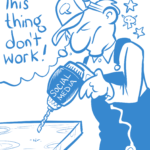
There are several plug-ins and apps that promise to automate your social media. Plug-ins like IFTTT and plug-ins like Jetpack promise to get your content out to several social-media platforms for you — freeing you to focus on more important things. Sounds great, right? I’m going to argue that it’s not.
The content you are trying to access is only available to members.











 Loading ...