This week, Dave returns from Alaska Comics Camp with a glowing review of what he calls one of the most...
Read More








I’m going to start the Book Cover Hot Seats this week. There’s still room in the Open Call if you’d like to participate.
The content you are trying to access is only available to members.

Q: I’ve started production on my second print collection of comics and was hoping I could get you to talk a bit about your book covers.
I like the layout of my first one, and I’m thinking of going with the same theme, but new title and new character illustrations, different colours, much the way you did the first four Evil Inc Annual Reports. You’ve started switching up five and six a bit, was this a business decision or personal design preferences? Are you finding the variety helpful or harmful to sales in any way? Do you have any recommendations, keep a theme, change the theme? And how important is it that the two books compliment each other side by side or on the shelf? For example, in terms of colours should I be worried if the two covers clash? Should I make a point to choose complimentary ones? (I don’t know if that’s over thinking on my part.)
The content you are trying to access is only available to members.
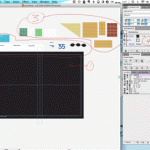
Today’s post is very kindly submitted by Margaret Trauth, creator of Decrypting Rita. As always, you can click on the images to get a bigger version of the image.
I figured it might be interesting to write a bit about my very idiosyncratic process of making comics directly in Adobe Illustrator. So here’s a start-to-finish about how a page happened.
The content you are trying to access is only available to members.
I was able to record the Business of Webcomics panel at Comic Con International on July 13, 2012. I moderated the discussion which featured Scott Kurtz and Robert Khoo.
The content you are trying to access is only available to members.
Today’s post is the last of a three-part series geneously submitted by Jaya Lakshmi. It started two Mondays ago, continued last Monday, and concludes today.
The content you are trying to access is only available to members.
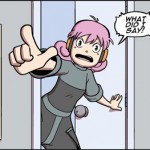
Today’s post has been very kindly submitted by Mary Cagle:
Something that drives me crazy about a lot of cel shading is that the artist only lines the edge of their figures with shadow.
As a demonstration, here’s a recent panel of my comic shaded in such a way:
The content you are trying to access is only available to members.
Folks, due to the breaking-news nature of this post, I’m bringing you tomorrow’s post today. There will be no site post tomorrow — unless more breaking news happens!
If you use PulsePoint (which used to be called ContextWeb), you may have noticed that your stats have dropped to zero since about July 12.
The content you are trying to access is only available to members.
As you may recall from this initial post, I’ve started experimenting with the idea of releasing all of my comics for a given month at the beginning of that month as a digital download. I offer a downloadable PDF for the iPad market, and I’ve used Kindle Direct Publishing to make a MOBI file available on Amazon.com for people who own a Kindle Fire.
When I released the July comic, I had a bit of a “waitaminute…” moment.
The content you are trying to access is only available to members.
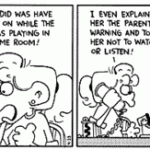
Today’s post is the first of a three-part series geneously submitted by Jaya Lakshmi. It started last Monday and it will conclude next Monday.
In the previous entry, we looked at two Calvin and Hobbes strips because Bill Watterson knew how to write humor. Now we shall see how two other cartoonists gained syndication and have developed reputable followings.
The content you are trying to access is only available to members.




 Loading ...