February To-Do List
Get out your calendar and start circling dates. It’s time to do a little webcomics planning.
Business
The content you are trying to access is only available to members.
Get out your calendar and start circling dates. It’s time to do a little webcomics planning.
Business
The content you are trying to access is only available to members.
You don’t need a subscription to read today’s post!
This is a re-post from the Webcomics.com archive. If you’ve ever been curious about the kind of information, tutorials and advice that you’ll get as part of your subscription to Webcomics.com, this is a good example.
If you’d like to join the site, you can get a 12-month subscription for $30 — or you can get a one-month Trial for $5 … with no obligation after your 30 days expire. For less than three bucks a month, you can get a steady flow of information, tutorials and advice targeted towards your webcomic business — plus a private forum to discuss issues with other professionally minded cartoonists.
Let me tell you why I love the UPS Store.
They made my life easier. And they’re saving me hundreds. Hundreds.
I’ve been shipping books to Diamond Comics Distribution, and it’s a huge pain. (That’s not a reflection on Diamond, of course.) Shipping large quantities of anything to anywhere is expensive as heck these days. And for any shipment over 500 pounds, Diamond makes the request that the books are strapped to a pallet (pictured to the right). That’s a couple hours of work to do it correctly.
Then you have to arrange for a freight company to pick up the pallet and deliver it to the appointed address. Unless you’re fortunate enough to live or work in a building with a trucking dock, that’s going to mean spending the extra money to have the driver bring a pallet jack on a truck with a lift gate.
ka-CHING.
Last year, I shipped a 900-pound shipment of books to Diamond, and all of the variables listed above applied.
The total for the shipment clocked in at well over $1,000. I have to check my records, but offhand, I remember it was close to $1,300.
And the palletting process? I work in a studio inside a rehabbed old factory building. But I wasn’t able to access the truck bays that month due to some other residents who had priority. That left me building my pallet in the parking lot, under a canopy my wife had bought for camping, hoping the rain in the forecast was going to hold off.
It took me hours to lug the boxes out to the parking lot, stack them, make sure each was labeled correctly, and then secure them to the pallet with plastic wrap.
And then the driver was late. Our 11 a.m. pick-up had turned into 6 p.m. He missed it by seven freaking hours.
When I called to bellow at the dispatcher, I was told that I should have never expected him to be there at 11 in the morning. That was just crazy on my part.
And even though I had submitted payment information while I was setting up the shipment, one month later, I was hit with a notice of delinquent payment.
So as happy as I was to hear that Diamond had sold out of that particular title, I wasn’t exactly looking forward to shipping them more stock — to the tune of a 500 pound shipment.
Like a man being walked to the firing squad, I took myself to the labyrinth-like Web site for UPS Freight. And after filling out digital forms for the better part of an hour, received a message that said that my shipment couldn’t be scheduled.
Great. That means a trip into the oxymoron-ridden world of Customer Service.
I dialed the phone.
Several days later (that’s not an exaggeration) I got a call back:
“Listen, bud. Why don’t you just take your books down to the UPS Store?”
“You expect me to drive five hundred pounds of books to downtown Philadelphia?!”
“Nah. They’ll pick them up.”
“Bullshit.”
He insisted that he wasn’t pulling my leg. So I wearily called the UPS Store at 17th and Market. Dave answered. Dave and I have become close friends.
“Oh, sure, we’re doing more and more of this. I’ll send a couple guys out with the van. They’ll bring the books over here. We’ll pallet them up, and get ’em out the door. No problem.”
No bullshit.
And they did exactly that. They drove out to the studio and picked up the boxes. If there was a charge, I don’t see it on my receipt.
Oh. The receipt.
You ready for this? $370.10.
• $270.10 for the shipping.
• $100 for the palleting.
Now this was about half of the previous shipment (which was over $1k), so I was expecting this to start at five hundy.
Just for the sake of comparison, I shipped 11 individual boxes, 30 pounds each, to the same location to fill a separate Purchase Order. That cost me $334 (for about 330 pounds).
And did I mention they picked up the boxes at my studio and secured them onto a pallet? For a measly hundred smackers? How about I tell you that this was the day after Christmas. And it was “no problem… happy to be able to help out.”
I love the UPS Store.
I was looking through my traffic statistics on Google Analytics, and I saw something odd.
Under my Referrals, the third-highest return was tpc.googlesyndication.com.
What the heck is that? And why is it sending me so much traffic?
The answer surprised me.
The content you are trying to access is only available to members.
As we alerted you several months ago, The US Postal Service is raising its rates.
Here’s what you need to know.
The content you are trying to access is only available to members.
Patreon has launched a referral program.
It works like this: You refer creators to Patreon, and then both you and the creators get a bonus based on the number of patrons that the newcomers get in their first 30 days.
The content you are trying to access is only available to members.
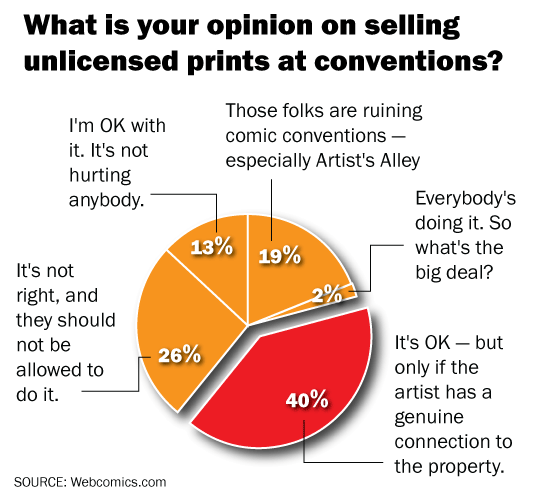
It happens regularly. An artist is outraged because someone stole their design! And when I click over, I see the design in question is a mash-up between two licensed properties that this person couldn’t possibly have the rights to. In other words, they’re complaining that someone stole the design that they stole.
And I always see the same justifications:
It’s Fair Use (or parody)!
and
I’m not making any money (or very little) off this!
Wrong, and wrong.
So let’s take a moment to understand Intellectual Property a little better.
The content you are trying to access is only available to members.
With the first several Webcomics Weekly podcast hosted with one provider, and the rest hosted elsewhere, it has always been difficult to listen to all of the Webcomics Weekly episodes — until now. Thanks to my new intern from University of the Arts, Hannah Gregory, I’m able to offer Webcomics.com members the complete archive of Webcomics Weekly — all in one place.
Just click here — or go the the list of Categories in the right-hand column, and click Webcomics Weekly. Better yet, use this handy index to find the shows by topic, helpfulness, and more!
Soon, I will have a much more prominent link on the site.
While we’re at it, I created a playlist for Surviving Creativity. You’ll be able to play all new episodes — and all old ones — in one place.
You don’t need a subscription to read today’s post!
This is a re-post from the Webcomics.com archive. If you’ve ever been curious about the kind of information, tutorials and advice that you’ll get as part of your subscription to Webcomics.com, this is a good example.
If you’d like to join the site, you can get a 12-month subscription for $30 — or you can get a one-month Trial for $5 … with no obligation after your 30 days expire. For less than three bucks a month, you can get a steady flow of information, tutorials and advice targeted towards your webcomic business — plus a private forum to discuss issues with other professionally minded cartoonists.
I’ve see it in my Twitter feed every day for what seems like months. It’s a solicitation for comics artists to enter a contest that’s being run by an organization that’s breathlessly touting FREE comics on the Web(!)
And, right on cue, we have anxious cartoonists exalting this as the Next Big Thing. They’re frantically assembling their submissions and doubtlessly dreaming of the five-digit payday.
If it weren’t so damned pathetic, it would be funny.
Once again, many of us are thrust into the role of Jackie Gleason’s legendary character Ralph Kramden, whose get-rich-quick schemes provided comedy gold for The Honeymooners. And — more often than not — comedy gold is the only reward waiting at the end of the rainbow for cartoonists who keep falling for the same old come-ons time after time after time.
This has been going on since the beginning of webomics: Platinum Studios, Zuda, Tapastic, InkBlazers, LINE Webtoons, etc. They all had different approaches — and I’ll concede that some were arguably better than others — but they all had something in common. They all promised to deliver readers and money to cartoonists.
But have they? Has any of these ventures provided a livable income to a significant number creators for more than a year or two? If there is, I’m unaware of it. What I do see is a mass stampede of Ralph Kramdens running from one gimmick to the next. Who is making money on all of this? There seems to be an awful lot of venture capital being thrown around. But is it going into the pockets of creators?
Take InkBlazers (neé MangaMagazine) as a recent case study. They made this announcement a few weeks ago:
We have been trying to find a path for Inkblazers and unfortunately we have reached a point where we can no longer financially support the continuation of the site which cost us upwards of $65,000USD a month.
Why did InkBlazers fail? It doesn’t seem to be for a lack of funding. They seeded their company with a million dollars in 2012. Heck, just a few months ago, the Asia-Pacific Economic Cooperation was touting it as a success story! And the most recent annual report filed by Social Octopus Inc. (the company that owns Ink Blazers) looks awfully healthy, too.
So what happened?
I don’t honestly know. What I do know is that none of the above have delivered on their promises over the long haul. Will Tapastic fall in 2016? Will LINEtoons outlast them? It’s way too early to tell. But there’s a definite pattern, here. And it’s not particularly pleasant for the Ralph Kramdens among us.
Hey… if one of these organizations gives you ten dollars, that’s ten dollars you didn’t have, right?
I’ve written about the dangers of that mindset before. If you haven’t read it, it’s worth a look.
But let’s get down to brass tacks.
Here’s what you have to lose: Readers, mindspace, traction, SEO/PangeRank and — at the end of the day — money.
And it all boils down to the same concept: While you’re chasing after this contest… and then the next one… and then the one after that… what you’re not doing is concentrating on building your own business. Now, contrast the track records of the InkBlazers of the world with the track records of the people who have run their webcomics as their own small businesses.
Which method has elevated more creators to the status of full-time creative professionals?
Did Zuda? Did Ink Blazers? Did Platinum Studios?
Worse yet. When these organizations go down the tubes, what happens to the creators who signed on to Live the Dream? Their primary source of income vanishes. They have little or no efficient way of directing the readers they did generate to a new URL. If they haven’t launched their own site, they lose SEO and PageRank. And if they have, I’ll argue that their SEO/PageRank has suffered from neglect. Will they convert on the mindshare they’ve earned among a certain audience? In other words, will their readers immediately seek them out in a new location? Or will those readers simply shrug — knocked out of their daily routine — and move on to something else?
What do you have to lose? How about TIME?
How about the time that you should have been spending building your own business — instead of yearning for the lottery-ticket solution?
How about the time you’re going to have to spend now — learning the skills you should have been learning gradually over the last several years?
Let’s face it. Losing money stinks. But you can make more money. Losing SEO is a bummer, but you can build that back up, too. Losing readers is heartbreaking, but the Internet is filled with new readers.
You know what you can’t recoup?
The one thing that you can’t get back.
Time.
Yoast SEO has long been a plug-in strongly endorsed by Webcomics.com. But a recent update has made it even more useful. Using its new social-media interface, you can fine-tune how your comic is presented when someone links to it on Twitter or Facebook.
Here’s a quick tutorial to help you use it wisely.
The content you are trying to access is only available to members.
This is the last installment in the current Hot Seat series. What’s a Hitch It / Ditch It critique? In short: I go to participants’ sites and list something they could improve (and offer my thoughts on how they could do that), and then I talk about something they’re doing well.
As always, this is only the beginning of the discussion. Members are encouraged to share their thoughts on the matter in the comments below.
The content you are trying to access is only available to members.