Eisner Awards — Call for Entries
It’s time to nominate work for the Eisner Awards! Here’s what you need to know…
The content you are trying to access is only available to members.
It’s time to nominate work for the Eisner Awards! Here’s what you need to know…
The content you are trying to access is only available to members.
FREE FRIDAY! Today’s post from the Webcomics.com archive can be read without a subscription! Over the past several weeks, I’ve been doing a lot of thinking about the future of webcomics. We’re in a period of significant upheaval, and rather than be frightened, I’m focusing on the opportunities that present themselves in such times.
I’ve written how social media has evolved the typical webcomics reader from a forager to someone who is force-fed. And I think that the way we handle that issue is going to define our future as content creators.
I’ve also written that I think many of us are going to have to turn to a subscription-based model (such as either Patreon or a traditional subscription-based Web site). Some of you got confused, thinking I was proposing this as the better method of serving readers. If this is you, I want you to read that post again carefully. It’s not the better choice — especially from the standpoint of readers. However, once ad revenue is removed, it just might be the only choice you have, if your goal is to earn an income through your self-published comics.
If you need any real-word examples of how this is playing out against the broader landscape, simply look to the new Star Trek series. It wasn’t available on Netflix or Hulu. Rather, it was exclusive to CBS All Access — the network’s own subscription-based delivery service. Throw in other existing services such as HBO Go, and it’s clear to see that a fantasy/sci-fi fan is going to have to keep several subscriptions going to continue watching shows like Daredevil, Star Trek, Game of Thrones, and so on.
The same thing is going to happen in comics, folks.
And the results aren’t all bad. For example, once we remove ad revenue from the equation, we’re free to rethink many things that were no-brainers for over a decade of Web publishing. And one of the biggies is this…
The archive was once the webcartoonist’s secret weapon. A big archive meant big ad-revenue dollars. Binge-readers generated significant returns on CPM advertising, and long,winding archives means plenty of SEO-based opportunities for a new reader to discover you.
Although SEO discovery is still important, ad revenue is a much smaller factor than it was a few years ago.
As a result, there’s a much smaller reward for keeping that archive readily available to binge-readers. Instead, I’m giving serious consideration to putting the majority of my archive behind a subscription wall. Now that Patreon has released a WordPress plug-in, you can offer that subscription-based archive to your patrons as yet another reward.
I would, of course, keep a healthy chunk of my recent work available for free reading. After all, that’s the best way to turn a new reader into a fan. But my goal now will be to leave just enough free content on my site to convert a fan… and then convince that fan to be a subscriber. After all, only a fan is going to subscribe to get deep-archive access. Finding that sweet spot is going to take a little experimenting. But I think it’s got tremendous promise as a revenue source.

Having discussed Instagram’s new algorithm, it occurred to me that I hadn’t discussed the new Facebook operating system. In case you missed it, a bunch of people are convinced, once again, that Facebook is going to kill their ability to reach their readers. And, once again, understanding this requires a deeper discussion on the topic. So let’s do that…
The content you are trying to access is only available to members.
I’ve been seeing a lot of discussion about the new Instagram algorithm. Although it’s virtually impossible to get verified information, I wanted to pass along some advice I gathered to help navigate these waters.
The content you are trying to access is only available to members.
This week, Brad and Dave welcome professional adventure cartoonist Lucy Bellwood. Lucy delivered a jaw-droppingly honest look at the life of a professional freelancer at the XOXO Festival last year, and it seemed only natural to discuss the importance of transparency in a profession so driven by social media. But first, Brad asks if they’ve ever performed a snow-day ritual.
If you have any thoughts whatsoever about becoming a professional cartoonist, this video is required viewing.
To be honest, it was a tip that I passed along, but personally dismissed. Patreon had been insisting that they had a simple way I could improve my ability to earn backers, but it was so simple, I decided it couldn’t be that important. I was wrong.
Here’s what I found out…
The content you are trying to access is only available to members.
The National Cartoonists Society has released its call for entries.
Here’s what you need to know:
The content you are trying to access is only available to members.
In the new episode of ComicLab, Dave Kellett and I tackle a deceptively important question: Why comics? This goes beyond the trite answers everyone give about childhood aspirations. And it’s downright crucial to know the answer for yourself — Why are you doing this? We drill deep on the topic.
You don’t need a subscription to read today’s post from the Webcomics.com archive! Part of the new dashboard that Patreon has rolled out is the Exit Interview. When a patron discontinues his or her pledge, they are offered an exit interview. This gives them a chance to explain why they’re leaving.
I’ve found this to be the classic good news / bad news situation. Here’s why:
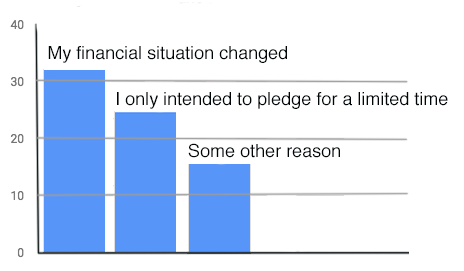
Patreon has long told us that the primary factor in a patron ending a pledge is that their financial situation has changed. And the statistics back this up pretty clearly. Just glancing down the page, makes it clear that an ended pledge is more about the patron than it is about the content being offered. (And, yes, I realize that this assumes that the ex-patron is telling the truth.)
The second-most-popular answer: I only intended to pledge for a limited time. That backs up a philosophy we’ve discussed here in the past. Many Patreon backers do not view their pledge as a long-term commitment. That’s important to note as you’re developing your rewards. If you’re setting up rewards that pay out over a long period of time, you may be missing a significant portion of pledgers who don’t plan to stick with you for that long.
Here’s how my responses (Since September) broke down:
So… the good news is this: You can stop beating yourself up over lost backers. Most of them have dropped out for reasons that have nothing to do with your content. And the others had a pre-determined time frame in mind when they joined. And your content did little to change that.
Perhaps the most-offered advice on the Internet is “Don’t read the comments.” It’s simple, the perceived anonymity of the Web emboldens people to write things that they’d never say to another person’s face. It’s for that reason that I’ve posted several pieces (like this one) that try to help properly walk the balance between gauging reader feedback and being creatively paralyzed by it.
The Feedback column in the Patreon Exit Interview has the potential to be just as frustrating as reader comments.
But the more dangerous area, by far, lies in getting to emotionally invested in these comments. I found myself obsessing over a single negative comment. The amount of brain space I devoted to it was — honestly? — depressing. What’s worse is this: Most of the comments in the feedback section were positive. But me, I couldn’t see those because I was too focused on the negative ones.
Now, as I’ve said before, you can’t afford to disregard comments from Patreon backers completely. In fact, I’ve argued that their comments should be taken much more seriously than run-of-the-mill reader comments. So, do take some time to read and reflect on the comments you’re getting there.
Just don’t let yourself get derailed.
On the preceding episode, I said that independent cartoonists should stop going to comic conventions. Co-host Cory Casoni said that creators should cross at least one off their list. As a result, we at Surviving Creativity found our feeds flooded with questions about attending cons… because, of course it did. So we’re diving deep into conventioneering from pre-show orders, to your post show P&L. Plus, a whole a slew of con stories and some good networking & etiquette advice for creators and attendees alike.