24-Hour Comics Day
24-Hour Comics Day is in a few weeks — October 6th, to be exact. Here’s what you need to know…
The content you are trying to access is only available to members.
24-Hour Comics Day is in a few weeks — October 6th, to be exact. Here’s what you need to know…
The content you are trying to access is only available to members.
Welcome to September, and the kids are headed back to school. If you’re a parent, that probably means that the time you’re able to devote to comics just tripled. Let’s talk about using it wisely.
The content you are trying to access is only available to members.
Recently, I saw a webcartoonist asking for advice on convention banners. It’s a deceptively tricky topic — and it’s something I see done poorly at con after con.
Before you shell out your hard-earned dough on another convention banner that doesn’t work, take a little friendly advice:
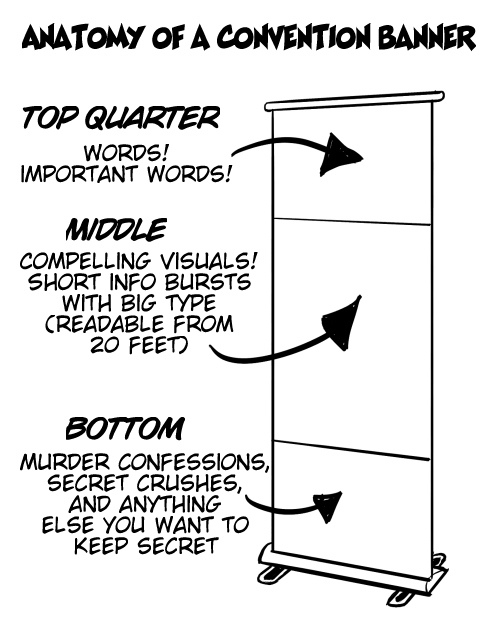
The primary purpose of a convention banner is to attract attention to your table. Therefore, you need to get everything as high as possible. Putting important information at the bottom of your banner is a mistake — especially if the banner is going to be placed on the floor behind your table. Think about it. No one sees anything below the middle of a vertical banner from the aisle.
For the same reason, any type that’s not readable from about 20 ft away is too small. Make that type big!
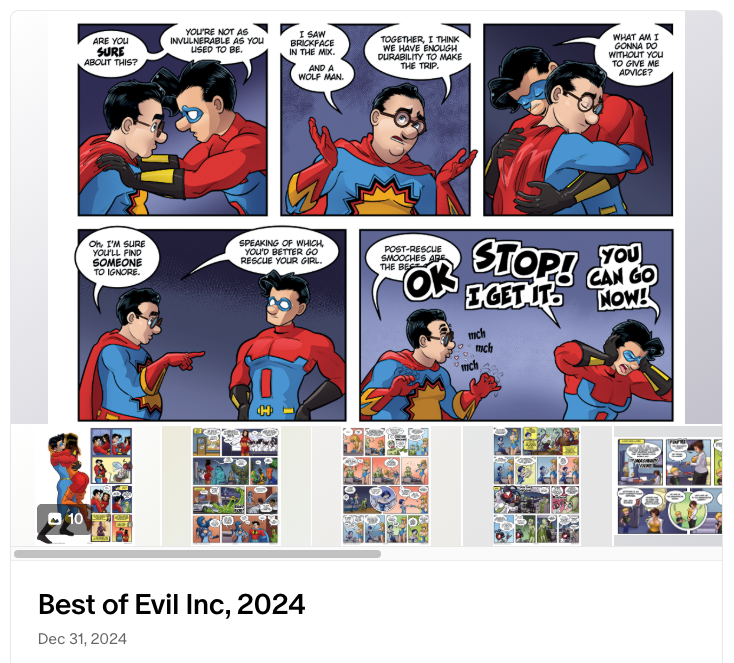
And here’s one that has become even more important as webcomics have grown — do you promote the comic or promote the creator? There are pros and cons either way. But make your choice consistent. If the banner promotes the creator at the very top, be sure that the listing in the program matches. After 16 years of conventions, I can’t tell you how many problems I’ve caused for myself by bringing my “Evil Inc” banner to a con that I’m listed in the program as “Brad Guigar.”
You’d think I’d learn…
Comics educator and author Scott McCloud calls them the “bulgy Edsels of comics iconography.” Indeed, cloud-like thought balloons are spurned by most comics artists.
Let’s talk about why that is… and whether it’s warranted or not.
The content you are trying to access is only available to members.
As a general rule, I don’t make public posts on Patreon. And the reason why means understanding one, basic truth…
The content you are trying to access is only available to members.
The next Webcomics.com Poll is a simple one. What I want to know is this: Do you design your comic primarily with smartphones/digital tablets in mind?
Traditionally, webcomics have been designed for desktop screens — and print.
However, designing a comic for smaller screens means — in many ways — adopting a layout that is distinctly not conducive to the printed page. Look at many comics on Webtoons for an example of what I’m talking about. Panels are stacked vertically to be scrolled down through on a smartphone screen. And the number of panels isn’t limited to what can fit on a page.
So… the question is this — which is your primary concern, when creating a comic: small screens or desktop/print?
Wanna do better at social media? It can be boiled down to two sentences.
Like less. Share more.
It’s very simple. You Like when you should Share, and you Favorite when you should Retweet.
First of all, get into the proper headspace. As a webcartoonist, you’re on social media for one reason — and one reason alone. You’re there to promote.
Your Aunt Mildred is on social media to post pictures of her nieces and to take quizzes that tell her which Deep Space Nine character she is.
You can do all of that (if you choose), but the primary reason you’re there is to promote.
And branding is a huge part of promotion.
Branding tells the world who you are. A good brand should have a headline and several sub-heads. In other words, there should be one theme that develops around the things that you post about yourself (and your comic). And, secondary to that, there should be several other themes.
What’s my brand?
HEADLINE
SUBHEADS
All of the above combines to create my personal brand. Is it accurate? Yes and no. All of the above are truthful, but my presentation of them is decidedly one-sided.
For example, if you follow me on social media, you’re going to hear a lot about my successes. I’m going to post positive stuff all day long. You’re going to hear much less about my failures and shortcomings. Is that because I don’t experience them? Hell, no.
It’s because I know why I’m on social media.
And it ain’t to tell you about my failures.*
So this: Liking and Favoriting are nearly invisible acts.
Sharing and Retweeting are highly visible acts.
If you want to reinforce your brand, you need to do so visibly.
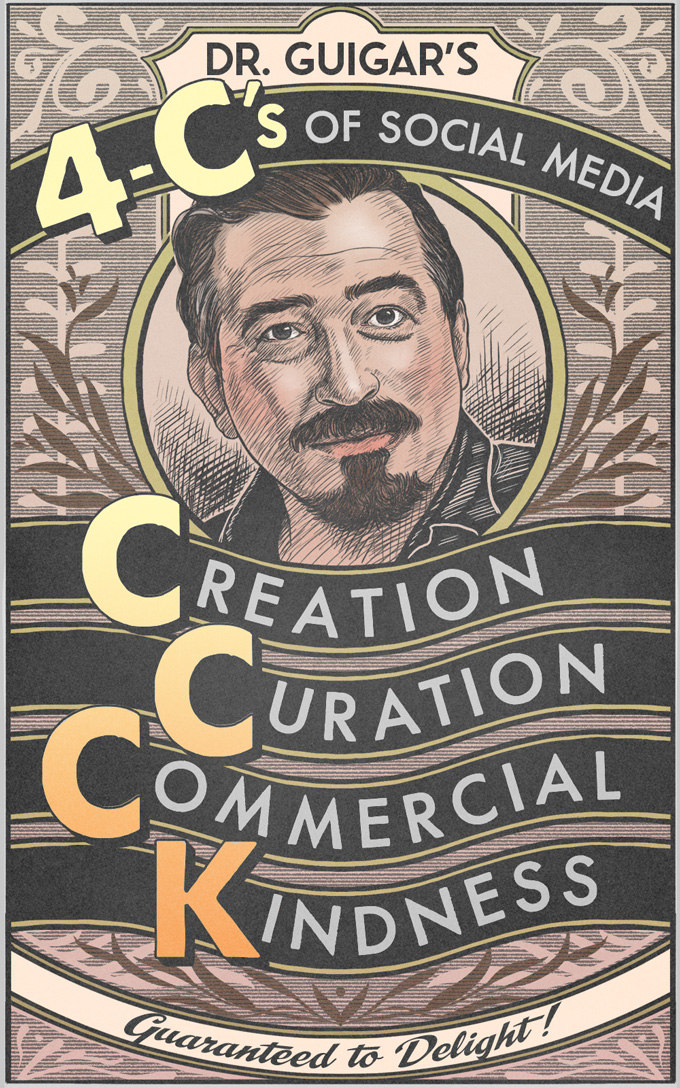
Beyond simple branding, this boils down to one core concept: The Three Cs of Social Media. Social media is about Content, Commercial and Curation.
Sharing and retweeting? That’s straight-up Curation.
Along with reinforcing my brand, Curation enables me to slide in more Commercials.
AND, since my Curation is MUCH more likely to generate engagement, when I DO post Commercials, they are FAR more likely to be seen by a larger number of people — because social-media favors people who make engaging posts. Go back and look a the number of Likes and Share those branding posts earn.
And that’s important to me because I know why I’m on social media.
Look at your own social-media feeds.
Do you know why you’re on social media?
The concept of a Hitch It / Ditch It critique is simple: I’ll take a look at your webcomic and identify one thing that you should consider improving. And then I’ll identify an area in which you’re excelling — not only as an encouragement, but as an example to others who would like to improve in that area as well. Leading off is…
By Bob Glasscock
The content you are trying to access is only available to members.
Webcomics wild things Dave Kellett and Brad Guigar are joined this week by lawyer-to-the-comics-stars, Katie Lane. She has some advice on attempting the elusive “working vacation.” THEN she discusses the legal questions that perennially haunt creative professionals, like how does one find a good lawyer? NEXT, she tackles work-for-hire contracts and right of first refusal. FINALLY, she shares some priceless advice… avoid one-size-fits-all legal advice. There’s no, one “right way” to do this.
BUT FIRST, as Brad shares his plans for a road trip to Michigan to visit his family, Dave recalls the family trips of his youth.
Show notes
Check out Katie Lane’s Contracts for Creative Freelancers at Skillshare. Her blog is Work Made for Hire.