I knew I had touched a nerve when I tweeted a conversation I had earlier with a fellow cartoonist…
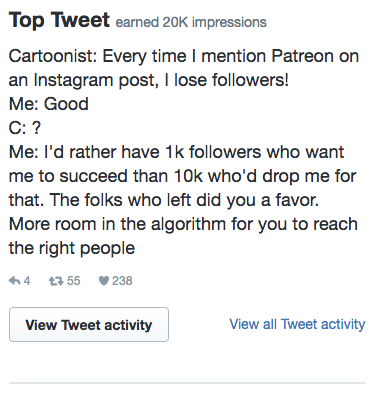
Cartoonist: Every time I mention Patreon on an Instagram post, I lose followers!
Me: Good
C: ?
Me: I’d rather have 1k followers who want me to succeed than 10k who’d drop me for that. The folks who left did you a favor. More room in the algorithm for you to reach the right people
— Brad Guigar (@guigar) April 6, 2018
The response was a groundswell of support. So let’s drill down on the subject…
A Thousand True Fans
Wired magazine co-founder Kevin Kelly advanced the concept of a thousand true fans in 2008, and it struck a serious chord with webcartoonists that reverberates to this day. In short, it posits:
To be a successful creator you don’t need millions. You don’t need millions of dollars or millions of customers, millions of clients or millions of fans. To make a living as a craftsperson, photographer, musician, designer, author, animator, app maker, entrepreneur, or inventor you need only thousands of true fans.
A true fan is defined as a fan that will buy anything you produce. These diehard fans will drive 200 miles to see you sing; they will buy the hardback and paperback and audible versions of your book; they will purchase your next figurine sight-unseen; they will pay for the “best-of” DVD version of your free youtube channel; they will come to your chef’s table once a month. If you have roughly a thousand of true fans like this (also known as super fans), you can make a living — if you are content to make a living but not a fortune.
Both Kickstarter and Patreon thrive on the idea of the 1,000 true fans. But that’s easy to forget in a culture that equates bigger with better — no matter what.
But bigger isn’t always better. There is no magic number of pageviews at which you get to quit your day job. And huge amounts of Facebook likes don’t always guarantee a huge audience for your message.
Rather, it’s all about investment. Specifically, it’s all about how invested your readers are in what you do. And a thousand fans who are emotionally invested in an independent artist’s work is more powerful — by mutlitudes — than a group of ten-thousand people who are only marginally invested.
Understanding algorithms
The response to me tweet wasn’t all positive. I received this reply, for instance:
I don’t know if that’s how the algorithm works, but yes, you don’t want to let fear of losing followers keep you from posting ways to support your work.
Let’s start here: No one knows the inner workings of the algorithm of any of the major social-media platform. That’s proprietary information that — if spilled — would allow users to game the system. But we do know some of the basics that apply across the board. Social-network gauge a post’s value by engagement. Engagement is any interaction with the post. For example:
- Likes/Favorites
- Shares/retwees
- Comments
- Clicks on links
- Opening a longer post to read it further
- Views (for videos, etc.)
No post gets distributed to the entire audience of any one social-media feed. It gets sent to a percentage of that potential audience, and then the social network’s algorithm monitors the engagement on that post. A heavily engaged post gets distributed to more and more people in the potential audience. Importantly, as this process moves forward, the potential audience increases from the followers of the original poster to the followers of that poster plus the followers of every subsequent person who shares the post. When a post gets distributed significantly further than the original intended audience, it is described as being viral.
And that’s where a smaller-but-invested social-media following wins every time.
SMALLER-BUT-INVESTED FOLLOWERS
Let’s assume a social-media following of 1,000 fans who are — overall — highly invested in a webcartoonist. When that webcartoonist makes a post, let’s say that 200 of them engage in that post in some manner. That’s a 20% response. Not bad at all! The algorithm picks up on this as evident of a post that even more of the followers might be interested in, and distributes the post to even more followers. If the engagement continues, the post continues to be distributed. If that engagement includes shares/retweets, the potential for engagement starts to expand. And of course, at some point, this wave of interest runs it course, engagement drops, and the post gets distributed to fewer and fewer people until it stops getting distributed entirely.
LARGER AUDIENCE WITH LOWER INVESTMENT
Now lets’ take that same post. But this time, let’s assume 10,000 followers. However, unlike the preceding example, these followers aren’t as emotionally invested in the webcartoonist they’re following. Those 1,000 true fans are still there, mind you, but they’re mixed into a larger group. Once the post is made, we’ll assume the same amount of engagement — 200 instances. However, 200 out of 10,000 is only 2%! The algorithm judges this post to be much less relevant than a 20% engagement and distributes it very little past the opening salvo. Even if it accounts for the bigger audience — even it if “grades on a curve” — that engagement is never going to rise much beyond two percent. As a result, that post dies an early death.
Losing followers and gaining success
That’s why I advised this cartoonist to celebrate Instagram followers who bailed when the artist mentioned their Patreon campaign. These followers are very unlikely to ever become Patreon backers. They probably won’t pledge to a Kickstarter either. They won’t arrive at a convention to buy a book. They’re non-entities.
And buy clogging your algorithm, they are — literally — preventing you from reaching your true fans!
Their departure is a blessing. Treat it as such.













 Loading ...