Let’s face it. One of the biggest hurdles in growing a webcomic is reader retention. That’s why I want to encourage you to set aside time this month to develop (or improve) three different ways to introduce your comic to a newcomer. Here are some ideas:
The content you are trying to access is only available to members.
This week, we’re talking about using a joke that you didn’t write. That topic leads into a discussion of the controversy that exploded after Alphonso Dunn posted a video accusing Jake Parker of plagiarism.
Questions asked and topics covered…
Using other people’s writing in your comic
The Inktober controversy — did Jake Parker plagiarize Alphonso Dunn
What should your highest-level Patreon tier be?
How to handle a word balloon from an off-panel speaker
Today we’re going to talk about a sentence that every last one of us have uttered:
I really feel like if I could get more people to see the comic they would actually like it…
There’s not a webcartoonist alive who doesn’t feel that way. Heck, I would imagine it applies to any creative profession. It’s one of our very few Universal Sentiments.
But it’s a mindset that misses an important point, and until you understand it, I think it’s going to hold you back.
What I think you’re missing is this: You’re already getting new readers. Every day. The question you should be asking yourself is whether you’re keeping the new readers you do get. And if that answer is no, you have to take a long, hard, objective look at why that is. If you think your comic is good — and if you’re not keeping new readers — then maybe it’s not as good as you think it is.
Quality is #1
Think about it. Every day you’re getting new readers. If they like your comic, they’ll become regular readers. If they don’t like your comic, they won’t.
Let’s do a thought experiment.
Let’s say I gave you a magic wand. With one wave of the wand, you could get a million people to view your site on one given day. On that day — poof! — a million potential readers. If that comic’s not good enough, how many of them are going to stay? How many of them will come back tomorrow? Conventional Wisdom tells us that you’ll get a decent percentage — but for how long? If that next update isn’t very good, you’re going to lose some of those. And unless you’re able to Bring It — with frequency, consistency and significant — on a regular basis, you will have lost most (if not all) of those million in the span of a few months.
Now, what would you say if I told you that you already have that magic wand?
It’s called your Web site. And although it’s not going to deliver that million new readers on one single day, it will deliver them over the course of the next year or two. If you’ve been publishing for a while, it probably already has delivered that many. Maybe more.
Have you kept them? If not… is it the wand’s fault?
I can’t tell you if your comic is good or not… but your traffic will give you some clues. Look at your update days. A high ratio of new visitors coupled with a high bounce rate tells you that you brought new people in the door, and they didn’t find anything there to encourage them to read any further.
And you have to compare both stats. For example, if you have a high ratio of return visitors — coupled with a high bounce rate — that’s an indication that those readers aren’t diving into the archive because they’ve already read that content.
Everything after the quality of the comic itself is secondary. But the two top secondary concerns are Web-site retention and social media.
Web-site retention
Take a moment and look at your site from the perspective of a first-time visitor. Now ask yourself:
Does your Web site retain readers?
Does your site load quickly?
Are you encouraging financial support in the form of sales, Patreon, and so forth?
Do you promote archive storylines?
Do you make it easy to navigate into the archive?
Can new readers find archived material based on their own interests?
Can a new reader easily figure out the concept behind your comic in an About page?
Does your site make it clear that there’s more going on than just that one comic they see?
Does your site make it clear that there are other ways to enjoy your content — books, eBooks, etc.?
In other words, what are you doing to make sure your new readers will come back tomorrow — or at least stick around for a little while longer and become increasingly interested in what you’re doing.
Social media
Now more than ever, reading habits are changing on the Web. That makes social-media outreach on the Web super-important. Readers rely less on bookmarks and RSS feeds — and more on social-media alerts. It’s just something we can’t ignore. I offer tons and tons and tons of tutorials and advice on this site to help members do their social media outreach better.
But as important as it is to have a healthy social-media presence, it’s absolutely crucial to make it easy for people to use social media to tell their friends about your comic. That’s why I always advocate having “share” buttons under the comic. Having buttons on your site that lead to your social-media pages isn’t nearly as important as having buttons on your site that enable readers to share your work.
If you’re not doing this, I think you’re making a very big mistake.
The rest?
Message boards are becoming less and less important (from a promotions standpoint) and paid advertising…? You have to put an awful lot of time and energy into making this a worthwhile investment of time and energy. Otherwise, it’s a gamble. Now that we’ve passed the tipping point in the use of ad blockers, it’s a complete waste of time and energy.
No easy answers
And that’s just the problem. It’s not a question of installing one simple plug-in on your site. And it’s not a question of improving a single punchline or story beat. It’s doing all of that — plus social media, plus a whole lot more — and doing it tomorrow, too, and the day after that… It’s an ongoing struggle. Next chance you get, ask a creative pro who you think has “made it,” and ask him or her what they did to get to that point.
Nine-chances-out-of-ten, they’ll tell you that they’ll let you know as soon as they get there.
It’s one of the most-often-heard complaints in webcomics today: How do I get my comic seen in a market that’s oversaturated with comics?
You’re… not gonna like the answer.
The market isn’t oversaturated
It’s a false premise.
The webcomics market isn’t oversaturated. Are there more webcomics in 2020 than there were in 2001? Unquestionably. But on the other end of that equation, webcartoonists working in the early 2000s didn’t have social media. So although there were fewer competitors, it was incredibly difficult to direct people to one’s site. Moreover, the vast majority of the potential readers didn’t even understand the concept of reading a comic on the Web.
Enter social media and viral promotion. Now, exposing new readers to a comic is vastly more efficient (and effective) than it was in those early days. And, predictably, there are also exponentially more people publishing comics on the Web than ever before.
So, the market is oversaturated, right?
Wrong.
Because we’re forgetting to factor in the most important variable of all: Quality.
Do a good comic
It is undeniable that there are more comics, but — let’s face it — most of them are pretty horrible. In fact, I’d argue that the ratio of good comics to low-quality ones is about the same as it was in those early days before social media.
However, since the main conduit for consuming web content is social media, the system itself eliminates most of the low-quality content.
When a low-quality comic is published on social media, the outcome is fairly consistent: Nothing happens. The creator might get a couple of favorites — perhaps from other webcartoonists expecting a quid pro quo relationship. Very few people are going to share it or comment on it. Overall, the net effect is that the post’s engagement will be negligible. And posts with little-or-no engagement get filtered out rather quickly by social-media algorithms.
If a webcomic is posted on social media and nobody sees it, is it even there? I’m going to argue that it’s not. And since the vast majority of content consumption on the Web happens through social media, these low-quality comics are certainly not having a significant affect on the saturation of the webcomics market.
On the other hand, posting a good comic — along with making adequate use of social-media best practices — will get engagement. Even if you’re starting from an audience of zero, eventually someone is going to see your comic. And if it’s a high-quality comic — a comic that connects with its audience — they’re going to engage the post. And as that happens, more and more people will be exposed to your (good) work. And their engagement will help you to steadily build a larger and larger readership for your work.
Those other low-quality comics are a non-issue. In a social-media sense, they’re not even there. And if they’re not there, they can’t saturate the market.
In short, you’re going to be better served by spending less time worrying about the saturation of the webcomics market and more time improving your skills (and your understanding of social media). In the end the former is nothing more than a weak excuse for failing to do the latter.
A person who was just starting to do comics asked a question in a forum for creators: “How long does it take you to do one four-panel strip?” He got a wide range of answers — each one of them as unhelpful as the next. He had asked the wrong question, and his creativity was going to suffer as a result.
The content you are trying to access is only available to members.
*From USPS.com: …the Postal Service is planning a time-limited price increase on all commercial domestic competitive package volume from Oct. 18 until Dec. 27, 2020. Retail prices and international products will be unaffected.
The planned price increase would go into effect at 12:00AM Central on Oct.18, 2020 and remain in place until 12:00AM Central Dec. 27, 2020.
The planned prices, approved by the Governors of the Postal Service on August 6, would raise prices on its commercial domestic competitive parcels – Priority Mail Express, Priority Mail, First-Class Package Service, Parcel Select, and Parcel Return Service.
Set down the sunblock, and step away from the pool. It’s time to start planning for December and January.
I know it’s hard to get into the spirit, but this is the time to start working on merchandise for the holiday shopping season. In recent years, webcartoonists have offered an increasing compliment of holiday goodies that have ranged from specialty T-shirts and mugs to holiday-themed greeting cards. And let’s not forget to add calendars to that list. Those will start appearing in stores by November — at the latest!
So, let’s take a closer look at some of those specialty products, and how we can start working now to be ready to compete when the snow falls.
Calendars
I’ve been pretty dour on calendars as merchandise in the past, and, truth be told, I’m still not a huge proponent of the practice. As I’ve stated before, calendars have a very limited shelf life. Few people buy them after January. That means you either have to have a very strong, dedicated readership to pitch to or you have to go Print-on-Demand (POD) which brings the unit profit way down.
I am a fan of the calendar-creation tool at Lulu.com. (Redbubble.com did awesome calendars. but the demand dropped so low, they discontinued them.) So, as long as I don’t invest too much time on it, I can usually justify putting out a POD calendar.
Sizes
Lulu gives you a choice between two sizes: a large-format calendar that measures 13.5 x 19 inches and a standard-sized one at 11 x 17 inches.
For a step-by-step walkthrough of Lulu’s calendar-creation tool, read this archive post.
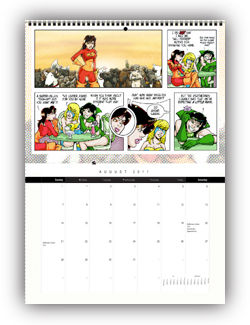
The large-format calendar (like the sample on the right) has a spiral-bound spine at the top, holding sheets of 13.5 x 19 -inch stock.
Add some extras!
Dates: Add some significant dates to the calendar
Your birthday
The anniversary of your comic
Any comic-related milestones (500th update, etc.)
Character-related dates
Pricing: Lulu allows you to set your own royalty, but try to keep the final price as close to $20 as possible (for the standard size). $30-range for the larger version.
Buying in bulk
Of course, you could buy a larger number of calendars for yourself, driving the unit cost down, and then try to sell them for a larger profit on your own site. You can do this through your POD vendor or you could invest in an offset print run. However, you risk buying too many and then being stuck with them in January when sales dwindle.
Of course, you can always use them as a loss leader to drive sales to your store later in the month.
September?!
When I released my 2010 calendar, it was November. And, truthfully, I figured this was plenty of time. One of my readers was very upset with me for releasing it so late.
I was perplexed. I couldn’t imagine anyone wanting to purchase a calendar before November, and yet, there was clearly a segment of my readership who had already completed their calendar-shopping for the year — and given the choice, they would have chosen my offering if it had been available.
So, the following year, I offered my calendar in early-October. And my sales were brisk.
But my new recommendation is to release your calendars at the beginning of September! I’ll get into why in a moment.
Artist Editions
About midway through the convention in New York, one guy who was buying a calendar asked for a sketch inside it — the way I do with books.
How did I overlook that?!?
Thinking on my feet, I asked him what month his birthday fell in. He said “April,” and I flipped the calendar open to that month and did a special sketch, with one of my characters delivering birthday wishes.
Every calendar after that had a special sketch on purchaser’s requested month.
Even though most conventions are canceled due to the Covid crisis, you should still plan to have your calendars prepped and available by September because if you do, you can order yourself a small stack and offer them on your Web site as Artist Editions.
Most storefront solutions include a way for the purchaser to communicate with the merchant. In PayPal, it’s “NOTE TO MERCHANT.” Advise your readers to indicate the month they want the illustration drawn in — and any birthday messages (if this is a gift for someone else, for instance) — and you’ve got a rock-solid early-Fall merchandise offering.
And your sketches could be simply your characters, or they could deliver birthday wishes, or they could contain references to the person’s astrological sign… the possibilities are endless.
Heck, you could do a very limited number of calendars with sketches on each day and sell it for a premium price.
Holiday cards
A few years back, I launched a couple of Christmas cards and the response was so overwhelming, I vowed to start earlier the following year so I could take advantage of this opportunity better.
Concept
Designing Christmas cards — and let’s note here that the term “Christmas card” is being used as a catch-all phrase for all of the holiday cards that get purchased during the winter holidays — is a lot like designing T-shirts.
No one is going to buy one with your character(s) on them. No one is going to buy them with your strip re-printed on them (unless maybe it’s a single-panel comic).
What they are going to buy are cards that express your unique sense of humor or your identifiable illustration style. It’s perfectly fair game to swipe a punchline from a strip. And it’s perfectly OK if the card has little-or-nothing to do with your comic.
Take the this good advice about designing great T-shirts and apply it to your Christmas card concept.
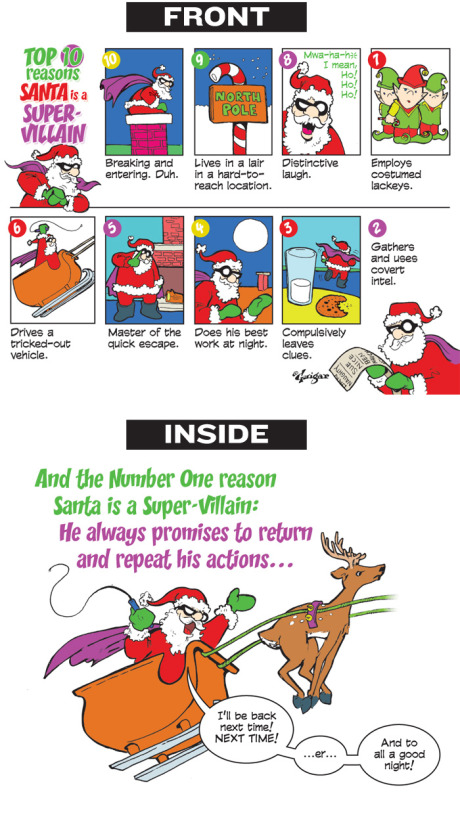
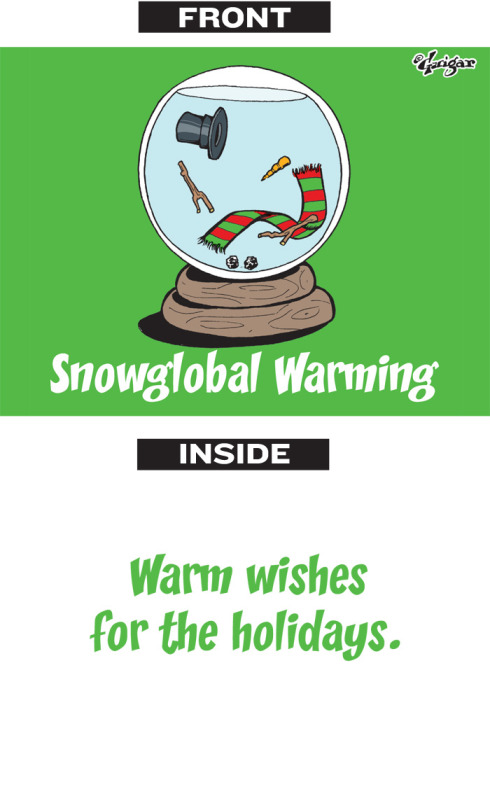
Like I said, I produced two that year. Both are posted a little further down. The first one is related directly to the theme of my comic, but had content that had not appeared in the strip (yet). The second one was completely unrelated to the comic. Both sold well, although the one that matched more closely the “Evil Inc” theme sold a little bit better.
When you think about it, designing a greeting card is very similar to creating a two-panel comic. The cover is the first panel and the inside can be the second panel.
In fact, it’s an incredibly effective two-panel comic because it’s impossible to look ahead to the punchline and ruin the build-up. You can build a nice amount of suspense that will charge the pay-off nicely. For example…
Of course, you can also approach it as a single-panel comic — with a nice, themed message on the inside.
Printing
The usual online printers are already offering specials for people printing greeting cards for the holidays. PSPrint has offered as much as 60%-off. Overnight Prints has offered 50%-off on holiday-related printing.
Make sure appropriately-sized envelopes come with the order. If not, buy some, and factor that expense in to your final price.
Shipping
Remember, you’re shipping off someone’s greeting cards. They need to arrive in good shape. I bought these cardboard boxes from Uline last year, and they performed beautifully.









 Loading ...