May To-Do List
Get out your calendar and start circling dates. It’s time to do a little webcomics planning.
The content you are trying to access is only available to members.Get out your calendar and start circling dates. It’s time to do a little webcomics planning.
The content you are trying to access is only available to members.While I was hosting my webinar* on webcomics for the Graphic Artists Guild, a comment came in from one of the attendees. This person said, “I think people avoid reading my comic because the archive is so big.”
I disagree. I’ll talk about why, and then discuss some strategies for creators with large archive.
*If you missed it, you can still see it if you’re a member of the Graphic Artists Guild.

If you’ve convinced yourself that readers avoid your comic because your comic is too big, I want you to consider something.
When is the last time you were reading a book and said…
“I love this book! This is a tremendous book! The characters! The plot! I’ve never enjoyed the simple act of reading so much. There’s only one thing…
“I wish there wasn’t so MUCH of it!”
You’ve never said that. No one in their right mind has ever said that. It’s nonsense. Conversely, have you ever said something like this…
“I love this book! This is a tremendous book! When I got to the last page, I go depressed because I knew it was coming to an end.”
See my point? If your comic is good — if it connects with its audience — that archive can never be large enough! If it has 4,000 comics, your audience will scream for 8,000.
But if it’s not good, your archive can never be small enough.
That’s not to say that handling a big archive doesn’t come with some challenges. So, let’s talk about some smart archive strategies.
If you’re like most of us, your archive is organized by whatever default system is in place. More than likely, it’s assembled by date. The problem is… nobody has ever said, “Y’know… I’m really in the mood to read a comic from May 2014.”
Your archive should be organized by content. If you’re doing a storyline-based comic, this is easy. The archive should be divided into those individual story arcs. And you should be identifying good places for a newcomer to jump in. You should have story synopses placed in strategic locations to facilitate these jumping-in spots.
If your comic isn’t storyline-based, you should be grouping your comics by topic. For example, a comic about cats could have the following categories…
You can take that strategy one step further and assemble those archive breakdowns into eBooks. Let’s face it. Your website offers a good reading experience, but an eBook is faster and cleaner. And, if you’re on a mobile device or a handheld tablet, an eBook is probably preferential.
Take the advice from the preceding section and build eBooks to sell on your site.
In the early days of webcomics, a large archive was beneficial. More comics meant more web pages, and more web pages meant more ads. With a large archive (and a little savvy SEO) you could generate a significant amount of ad revenue through people just bumping into random comics on the Web.
Well, the ad market has evaporated, and people are finding their new content on social media. And your large archive is mostly an added expense (in terms of bandwidth and hosting).
So you should be using the Patreon WordPress plug-in to put a large portion of your archive behind a paywall. This is an excellent reward to offer people at the lowest ($2) tier of your Patreon — unlimited access to the archive. And it’s the only way you’re going to benefit financially from that collection of work besides eBooks and printed books.
A large archive is not a barrier to success. If your work is good, it’s a tremendous advantage. And using some very straightforward, common-sense thinking you can use that advantage to its full potential.
Cartoonists Brad Guigar and Dave Kellett talk about how to balance good storytelling with your own personal taste.
Questions asked and topics covered…
Today is a great time to bump up your ComicLab membership to the $10 tier! Patreon backers at that level will get exclusive access to livestream recording sessions — as well as an archive of previous livestreams!
Listen to ComicLab on…
I accept criticism on my art from two sources: peers who are on a similar journey who I reach out to for advice (like an art-school critique, for example) and people with a demonstrated proficiency in my field. You’ll notice that the list does not include comments from individual readers or people who claim to be critics on websites, podcasts, social media or video. Here’s why…
The content you are trying to access is only available to members.One of the biggest creative challenges I face every week isn’t found in writing an epic storyline or drawing a masterful three-point perspective cityscape. Rather, the most imposing hurdle I have to clear — week after week — is getting started.
The content you are trying to access is only available to members.We’re often tempted to jump into crowdfunding — Patreon, Kickstarter, IndieGoGo, etc. — before we’re really ready. And that can be a big mistake in many ways. So let’s talk about getting our timing right.
The content you are trying to access is only available to members.Steven Spielberg was rejected TWICE by the University of Southern California’s School of Cinematic Arts. Walt Disney’s newspaper editor told him that he ‘lacked imagination and had no good ideas’. A perceived failure often tends to be the gateway to a bigger success. That’s why I think we spend too much time worrying about what happens if our Kickstarter fails.
As creators, we tend to take market success very personally. After all, it’s our personal vision that’s ultimately being accepted (or rejected) by our audience. As a result, we look at a Kickstarter as a thumbs-up/thumbs-down vote on the quality of our comic. After all, successful creators don’t launch failed Kickstarters, right?
Wrong. The fact is that several successful creators have launched failed Kickstarters. Hot Lunch, by British manga creators, mayamada, failed its 2018 Kickstarter by just over a thousand dollars. Eight months later, the campaign was relaunched. This time around, the campaign was funded in 9 days and became a Kickstarter staff pick along the way.
What happened in those eight months? Looking at the two campaigns, it’s pretty easy to see that the creative team took the lessons they learned to heart and retooled their approach based on that information. In other words, they used their “failed” Kickstarter as free market research.
Before a corporation brings a product to market, it typically spends large amounts of money doing market research. What they want to know is simple: Is this product a good fit for customers? Sometimes they may find that their product is not ready for the marketplace. In other case, they might actually find out that the market itself simply isn’t ready for the product. (The Apple Newton and WebTV — a precursor to the digital tablet and an early streaming-media service, respectively — were both failures to consumers who just weren’t ready yet.) The money spent on market research can save an exponentially larger sum that comes with a failed launch.
A Kickstarter is free market research.
When you use Kickstarter to present your product to your readers, you’ll find out in 30 days if its ready for the market (or if the market is ready for it.) If it’s ready — congratulations! You’ve got your work cut out for you, and it’s time to get busy. But if it’s not, it’s not the end of the world. Heck, it’s not even the end of this project!
Your readers just gave you for free what most corporations pay through the nose for. It’s up to you, however, to take the time to understand what your readers were trying to tell you. Was there a lack of support for the item itself? Maybe the price was too high. Can you downscale? Maybe use a different paper. Maybe start with a softcover and hold the hardcover back as a stretch goal.
Likewise, maybe you tried to do too much with your Kickstarter — adding in enamel pins and prints and posters and other tchotchkes. Perhaps it’s time to focus on the basics and keep it simple. Is the lack of support on Kickstarter paired with a general lack of enthusiasm for your comic in general? Maybe it’s time to take an objective assessment of your skills as a cartoonist. Or maybe it’s a good time to consider launching a new project.
In the same way that Walt Disney didn’t let his newspaper editor define his success, you’re not going to let this Kickstarter define yours. Instead, you’re going to embrace this as an opportunity to grow as a creator. Part of that requires you to process this event properly.
So, your Kickstarter didn’t reach its goal. You’ve been pushing it for a solid month, and now you have to make that awkward post in wish you thank everyone for their support. “We came darned close,” you’ll tweet, “but it just didn’t happen this time. But thank you to everyone who pledged anyway.” It feels as is this failure now defines you. You’re The Cartoonist Who Crashed and Burned. It’s probably a little hard to work on that next update. After all… your readers are probably just going to roll their eyes.
At least, that’s how it feels to you.
Meanwhile — for better or worse — the truth is much simpler. After a couple weeks, nobody even remembers that you had a Kickstarter. Your average social-media follower has been bombarded with thousands — thousands — of messages over the past fourteen days. Let’s face it, they’re lucky they remember their own names at this point. In that same span of time, they’ve had their own successes and their own failures. And — to them — these are exponentially more important. They have their heads — and their hands — full. Keeping track of you and your little ups and downs isn’t really realistic, is it?
So, while you’re huddled under the covers, digging into another pint of Ben & Jerry’s, nursing your heartache and bandaging your ego*, your readers have moved on. (And they have the right idea.)
All kidding aside… take some time for self care, but then get off your butt and get back to work! Give that Kickstarter some objective scrutiny. Ask a few friends for their input. Run it past some fellow creators who have handled successful Kickstarters to get their thoughts. Reassess. Retool. Rethink.
And then relaunch.
*I can only assume you process grief the same way I do.
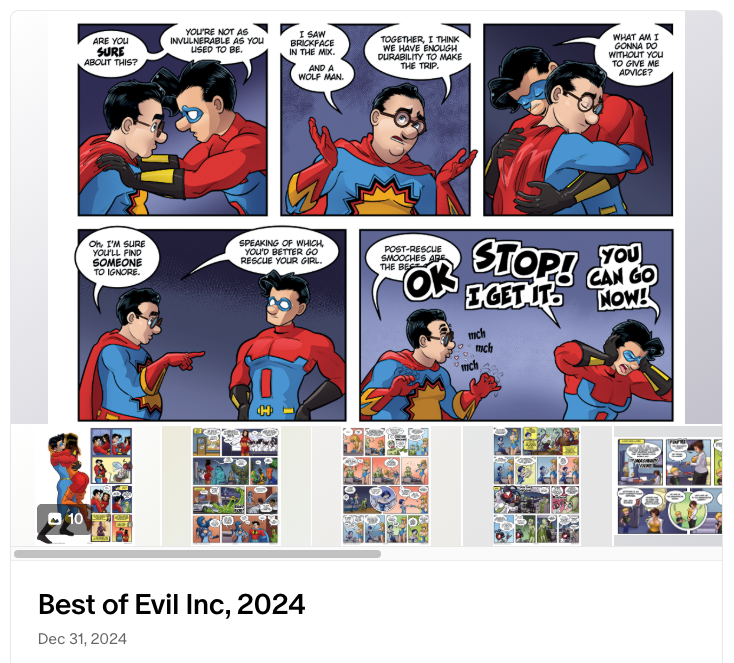
Cartoonists Brad Guigar and Dave Kellett discuss the pros and cons of livestreaming your comics-creating process.
Questions asked and topics covered…
Brad Guigar is the creator of Evil Inc and the author of The Webcomics Handbook. Dave Kellett is the creator of Sheldon and Drive.
I think it’s one of the pervasive mistakes made by webcartoonists today — they’re doing strips when they ought to be doing longform comics. It’s an easy mistake to make, after all. Most of the webcomics that have caught our attention in the early part of webcomics history (2000-2010 or so) have been comic strips.
The content you are trying to access is only available to members.So, you’ve decided to get a quote from and honest-to-goodness printer for your next book run. You’ve e-mailed a quote request, and you’ve gotten a prompt response. One that you cannot decipher for the life of you. Fear not, here’s a quick guide based on an actual book quote:
The content you are trying to access is only available to members.