A listener asks if they should write one big, successful comic or several mediocre ones. We have a bigger question: What makes you think you have a choice?! Also, it turns out the whole “Substack nazi” thing was yet another case of Platform Panic.
Many of the people who were making the most noise on this issue are switching to Ghost. Check out Ghost’s TOS — in which they’ve even highlighted their clause on refusing to moderate content! And, on top of that, the total number of nazi accounts that were found on Substack was only 5 or 6, none of them monetized, and collectively had fewer than 200 followers– and most of them wound up being taken down by Substack anyway.
It’s an inevitable part of getting better at comics. You look back on your earlier work and cringe. (And the better you’ve gotten, the more intense your regret!) Then, perhaps as you’re considering your first printed collection, the thought crosses your mind: “Maybe I should re-do these…”
You shouldn’t. I’ll tell you why.
The content you are trying to access is only available to members.
It’s one of the great Good News/Bad News situations in independent comics: Someone wants to buy your work! That’s wonderful! But… how do you determine a price?!
The content you are trying to access is only available to members.
BE ADVISED: We’ll be discussing issues like death and dying in this episode. Dave turns fifty years old, and it has us talking about cartooning in the second half of one’s life. And we’re not the only ones asking existential questions. Our first question asker is worried that they’re not going to have time to work on all of their ideas in one lifetime! Finally, we break down Wacom’s troubling use of AI art in a promotional image!
In light of a gradual breakdown of social media, one of my areas of focus this year is to find non-social-media methods to promote my comic. Getting invited to talk about your comic on a podcast can be effective promotion. But many comics creators just aren’t very good at… talking. And you can’t do promotion if you’ve bored the audience to tears. It’s OK if you’re not naturally lugubrious behind a microphone. With the experience of over a decade of podcasting, I’ll tell you the one secret that will turn you into an amazing podcast guest.
The content you are trying to access is only available to members.
We use dominant personality traits to find our place within groups — whether it’s friends, co-workers or neighbors. One might be the “mamma bear,” while another is a “loner.” The members of the group will begin to identify each other using these personality traits. They’re using character archetypes.
The content you are trying to access is only available to members.
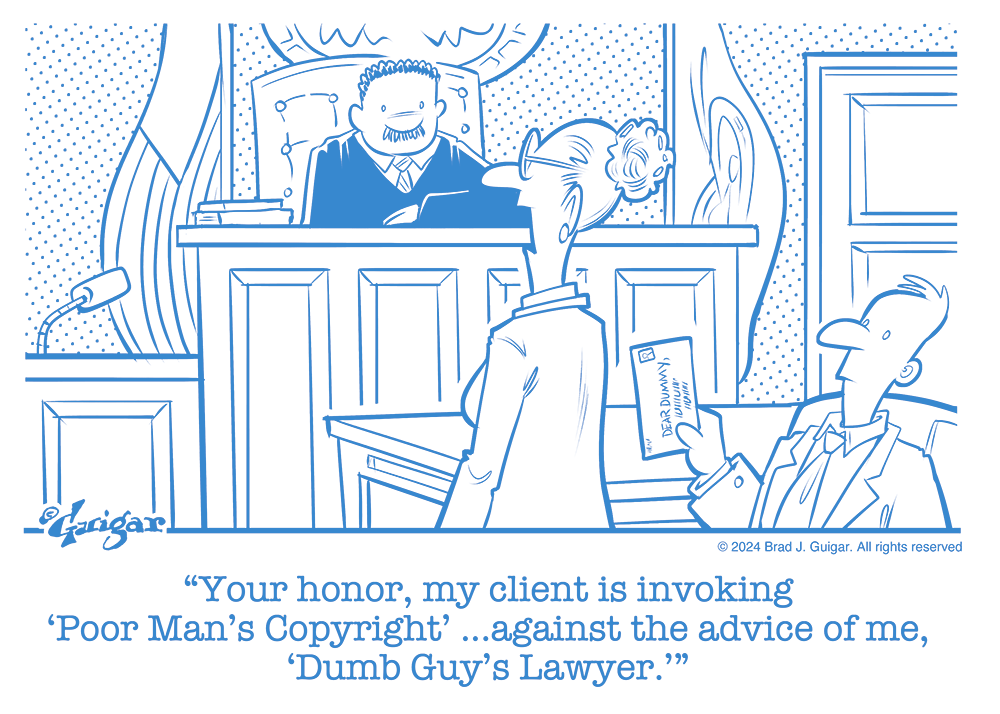
Poor Man’s Copyright is a system of attempting to establish copyright through mailing a copy of the art to yourself (some people suggest using Certified Mail). The artist then files the envelope — unopened. If their copyright ownership is ever threatened, all they need do is open the envelope (in a court of law, one supposes) and present the document with a flourish. You even see some very prominent artists advising young people to use Poor Man’s Copyright. There’s only one problem: It’s complete bullshit.
The content you are trying to access is only available to members.
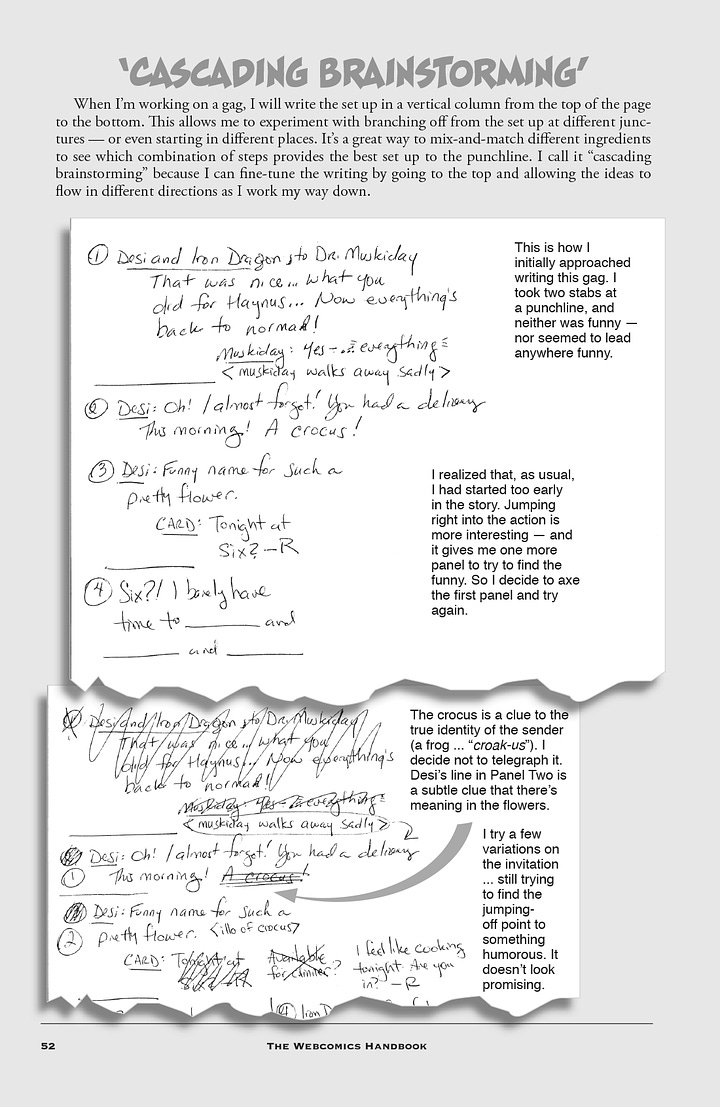
If you have a copy of my book, “The Webcomics Handbook,” you can find a discussion of my Cascading Brainstorming technique on pages 52 and 53. The pages look like this…
Cascading Brainstorming, from “The Webcomics Handbook”
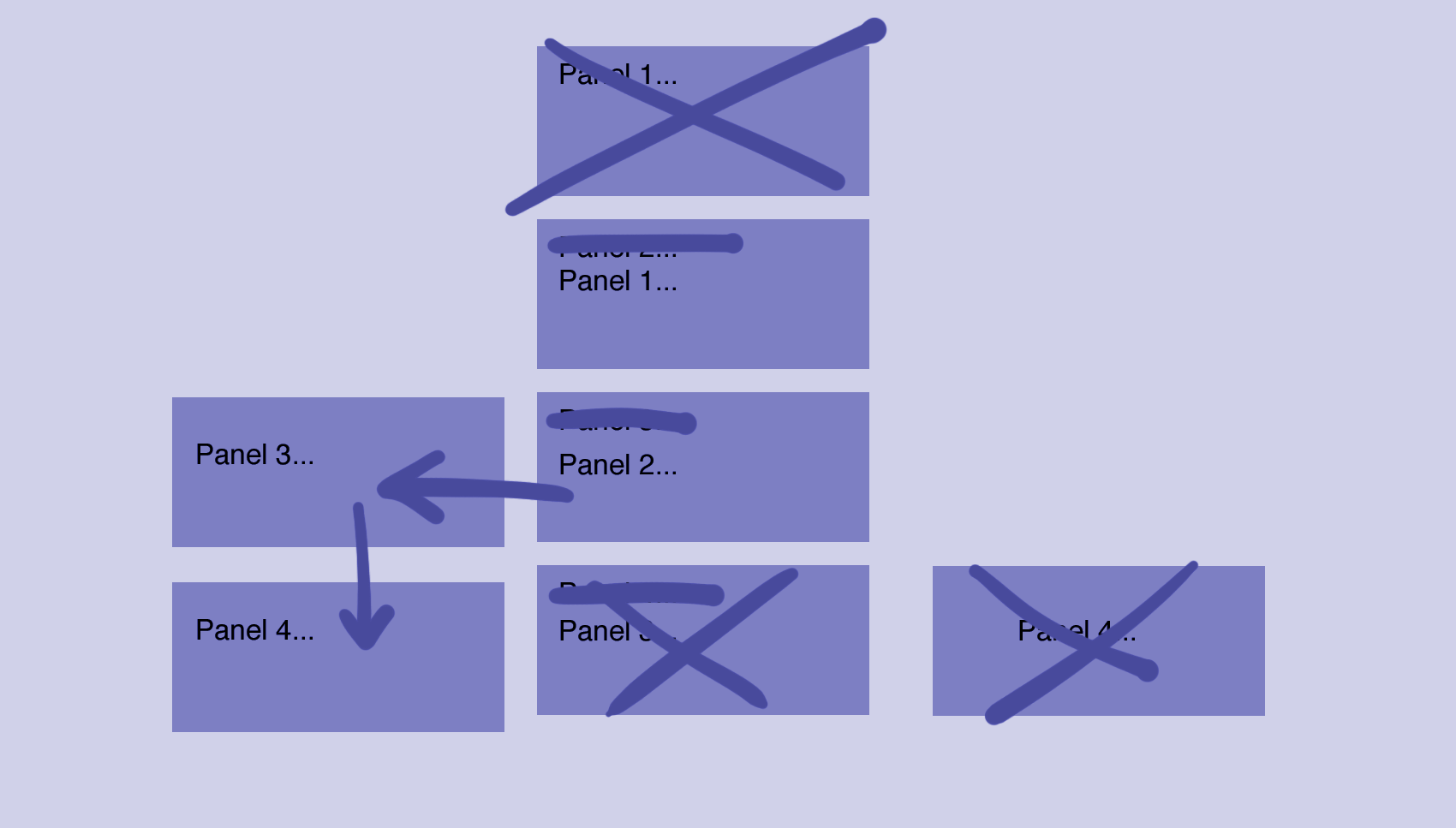
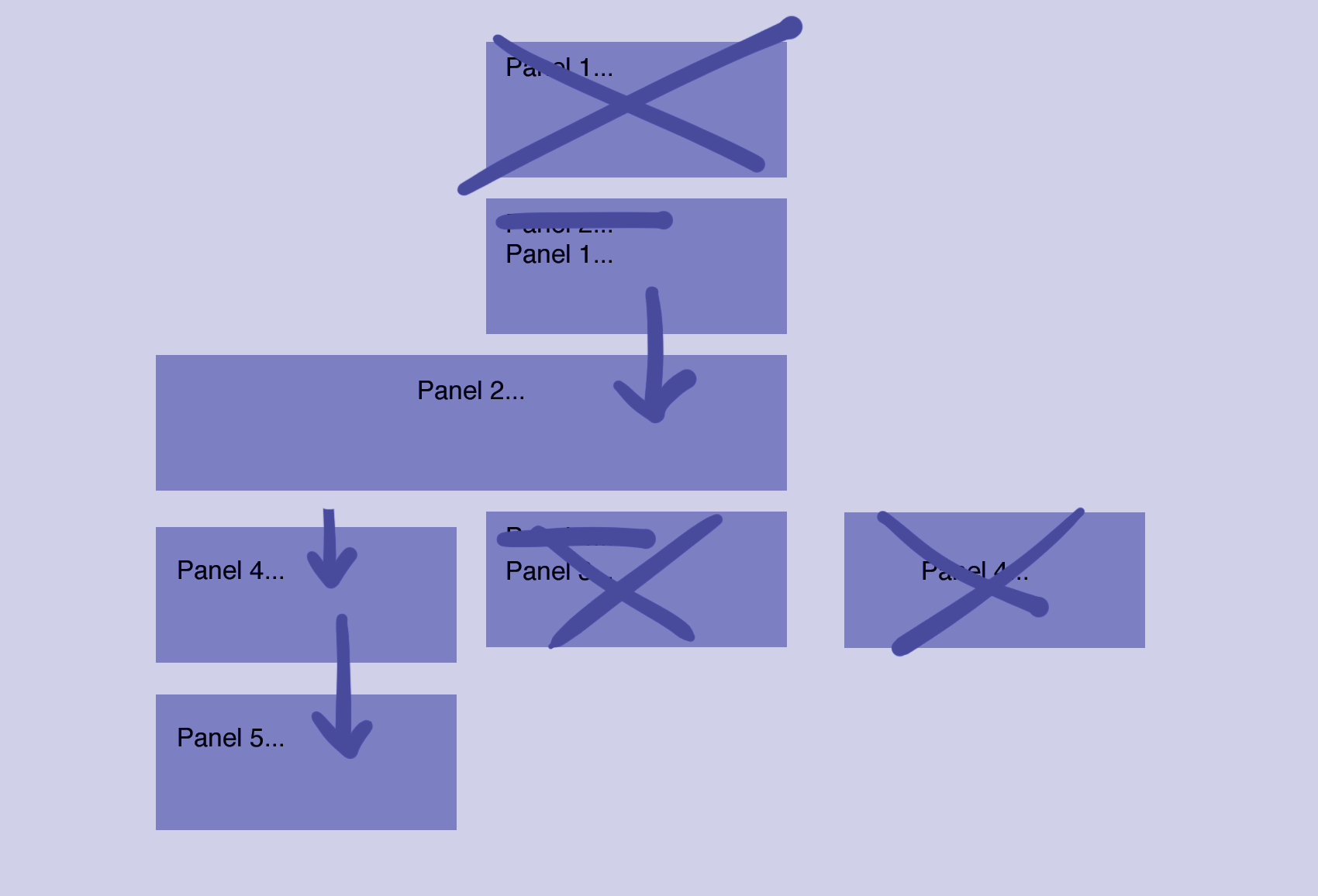
Here’s a step-by-step tutorial on how this process works. For this example, I will be trying to write a classic four-panel comic strip. I start with a clean sheet of paper in my sketchbook, and I start writing dialogue for each panel in a single column down the middle of the page.
If I hit something funny, then HOORAY! I dance my way over to my drawing table.* But that… rarely happens. Now, I actually have to sit down and write. More often than not, I find out that I really didn’t need the entire first panel. Conveniently enough, for this example, that’s exactly what happens.
I cross out the first panel (lightly), and I try to find a new punchline at the end of the string of dialogue. Any panel I cross out gets crossed out lightly because you never know when a previously “bad” bit of dialogue suddenly becomes brilliant as the parameters of your concept change!
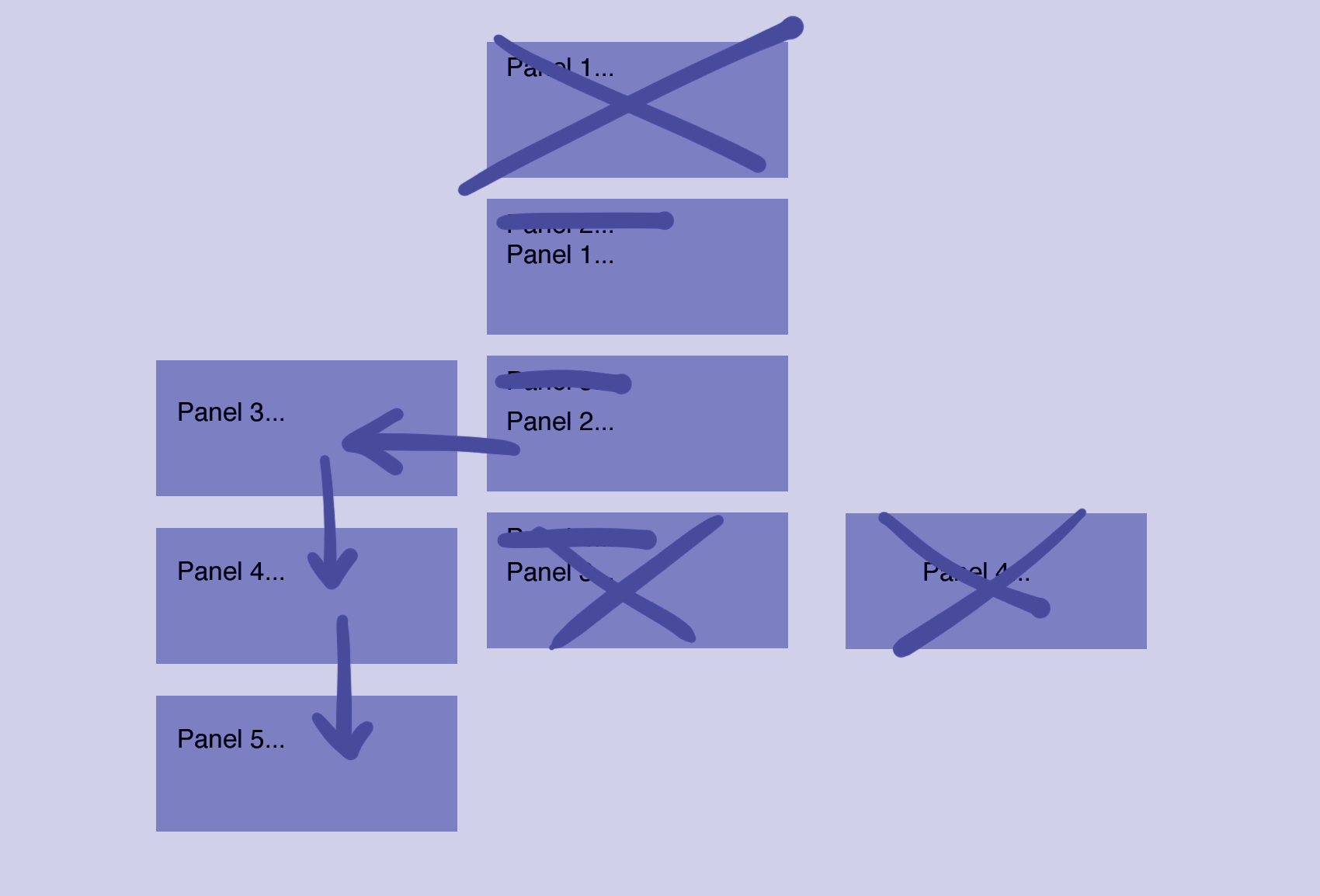
Unfortunately, I still haven’t found the Funny. That’s where the “cascading” comes in. I think of a new direction the concept could go. In this case, I write a new Panel Three, and then I see what that leads to. Perhaps something Funny in a new Panel Four!
Nope. Still not there. Writing funny is hard. Here’s where I usually pull out another trick I wrote about in “The Webcomics Handbook” — One More Panel. If I didn’t find gold on Panel Four, I write a fifth panel… and maybe a sixth… and so forth.
The object of this is not to come up with a comic that is greater than four panels! For the sake of this example. let’s say that I found something truly Funny in the new Panel Five I’ve written.
Now I edit. What used to be the second and third panels might be combined into one. And now I have my four-panel comic strip.
Writing is hard
At the beginning of this tutorial, I made it a point to mention how I usually started in the middle of a clean sheet of paper in my sketchbook. Often, I’ll try to start on a left-hand page in the book as well. That’s because I know my “cascades” are probably going to flow over multiple sheets. In fact, by starting in the middle of a two-page expanse, I’m mentally preparing myself for the process I’m about to undergo. The cascades may go on for several columns. New cascades may start from the ashes of old ideas. I may abandon concepts entirely and earmark them so I can return to them later.
*And at the end, when I come to a combination of set-up and punchline that I really like, I actually don’t dance to the drawing table. I know from experience that writing means re-writing and re-writing and editing, and good editing needs time. I need to give my brain time to forget the mental zeitgeist that brought me to this particular writing solution. Forget the mindset. Forget the Moment.
Often, I come back a day or two later. I see all of the flaws I couldn’t have seen before. And then, it’s time to start re-writing, refining, and rethinking. The Funny is in there somewhere, and the Good Stuff is worth hunting for.










 Loading ...