October To-Do List
This is a time when creativity seems to be at an all-time high everywhere you look. From carved pumpkins to costumes to haunted houses to the really scary stuff like, well…
A young person majoring in Sequential Art at a well-known art school wrote in with a list of twenty questions for me. I was happy to answer them, but since the questions seemed so universal, I asked permission to answer the questions in the form of a video so I could share it with others as well. This is the second of a series that will be in four parts — maybe more.
In this installment, I talk about going on hiatus — how long you can be gone and how to communicate this with your audience. Also… how do you find time for social media and things like Patreon? When is it time for Patreon/Kickstarter when you’re just starting out? When should you hire a colorist/assistant/letterer? And how do you find a good editor — and how much should you expect to pay?
The content you are trying to access is only available to members.It’s one of the most-often-heard complaints in webcomics today: How do I get my comic seen in a market that’s oversaturated with comics?
You’re… not gonna like the answer.
The content you are trying to access is only available to members.It’s no surprise that video has impressive power on social media, but did you know that — as a cartoonist — you have a steady supply of video content?
Like many of us, I’m constantly trying to build my social-media following. And I’m constantly trying to share special content with Patreon backers. As a result, I’ve gotten into the habit of (a) hosting livestream events and (b) recording my drawing process. And that means I have a decent amount of drawing video to work with.
In trying to repurpose that raw footage, I’ve found that timelapse videos have been generating an impressive level of engagement. This has been especially true on Instagram, which has proven to be a social-media platform tailor-made for comics and cartoonists.
So let’s talk timelapse tips!
The content you are trying to access is only available to members.24-Hour Comics Day is in a few weeks — October 5th, to be exact. Here’s what you need to know…
The content you are trying to access is only available to members.
Comics educator and author Scott McCloud calls them the “bulgy Edsels of comics iconography.” Indeed, cloud-like thought balloons are spurned by most comics artists.
Let’s talk about why that is… and whether it’s warranted or not.
In the early days of comic-book history, as artists and writers struggled to build the lexicon of a fledgling art form, it’s no question that the thought balloon was becoming a crutch. Instead of a glimpse into the thoughts of a character, it was a way of explaining action and plot that should have been illustrated instead.
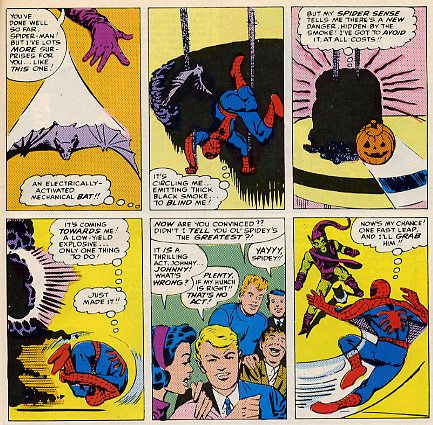
There’s no doubt that the early Lee/Ditko Spider-Man comics were thought-balloon heavy.

In Panel One, the thought ballon “an electrically-activated mechanical bat” attempts to explain a plot feature that should have been conveyed through illustration instead. Panel Two also uses a thought balloon to do the job of the illustration. In fact, you can see it happening throughout the scene above.
As comics art matured, this overuse of expositional and explanatory thought balloons became frowned upon.
And although comics legend Jack Kirby famously used movies as inspiration for his visuals, the comics industry itself was soon regarding Hollywood as a competitor for consumer dollars as well. And comics artists were encouraged to go beyond inspiration, towards emulation.
Comics writer John Ostrander reported that he was forbidden from using thought balloons “because they didn’t have them in movies.”
Although it was a good idea to limit the overuse of thought balloons, the fact remained that conveying inner thoughts efficiently was a necessary part of some storytelling.
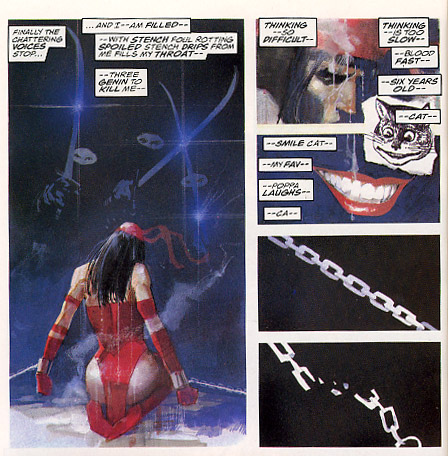
When writer/artist Frank Miller presented Elektra’s internal monologue in narration boxes, it quickly became adopted as a replacement for those exposition-heavy thought balloons.

Even today, narration boxes are greatly preferred for internal monologue, and thought balloons are given a weary side-eye. In fact, McCloud considers thought balloons to be patronizing in their very nature! (Somehow the pictogram thought balloons of Asterios Polyp are spared this scorn.)
I like thought balloons — used correctly. Those early craftspeople were right in rejecting the thought balloon used as a storytelling crutch. But criminalizing thought balloons entirely is like throwing the baby out with the bath water.
Comics writer Kurt Buseik may have put it best: “Eschewing thought balloons as a creative choice can result in interesting approaches. Eschewing them as a blanket formula, though, is just dumb.”

UPDATE: The USPS has negotiated a deal that enables them to stay in the Global Postal Union. From CNBC:
According to FreightWaves.com:
Barring an eleventh-hour agreement, the U.S. Postal Service (USPS) will leave the Universal Postal Union (UPU) on October 17, ending 144 years of U.S. involvement in the international body that governs the exchange of mail and postal parcels between countries, and perhaps fundamentally changing the landscape of global air shipping.
The piece goes on to quote Matthew White, a strategist for iDrive Logistics, in estimating a price increase of “at least 300%” for shipping internationally into the United States. Since the USPS will cancel negotiated service agreements (NSA) covering international shipments if the withdrawal takes place, U.S.-based international shippers will also pay more.
That means US-based independent creators shipping things like Kickstarter rewards to backers overseas may be paying much more in shipping costs. If you have a Kickstarter in the works — or if you’re offering physical merchandise to Patreon backers — this is going to impact your cost estimates significantly.
Shipping software provider released the following on Sept. 19:
Background
On Oct. 17, 2018, the White House announced the start of a one-year withdrawal process from the Universal Postal Union, a United Nations organization established in 1874 that regulates global mail delivery and rates among its 192 member countries. The primary concern of the White House is the subsidized rate set by the UPU for delivery of lightweight packages sent from countries such as China. That rate, which is much lower than the domestic delivery cost charged by the U.S. Postal Service to American shippers, puts US e-commerce businesses at a disadvantage.
In an effort to keep the United States in the organization, UPU members will vote for proposals to reform the terminal dues system at the UPU Extraordinary Congress scheduled for Sept. 24-25 in Switzerland. However, if the outcome is not satisfactory, the U.S. may leave the organization — a scenario that will create uncertainty and possible disruption of USPS international shipping.
New GlobalPost international shipping services
The newly introduced GlobalPost international services are not reliant on U.S. relationships with the UPU. Our network leverages partnerships with international postal operators as well as commercial carriers to offer worldwide delivery with quality postal services at extremely competitive rates.
Whether or not the United States withdraws from the UPU, GlobalPost will allow you to continue to ship internationally with similar transit times, customs clearances and competitive rates. Best of all, GlobalPost services include features not found in traditional international offerings, including:
For more information about GlobalPost, please visit our FAQ.
This episode of ComicLab is sponsored by Wacom! In this week’s show, the ComicLab guys discuss how converting to a digital workflow on Cintiqs improved their time management. Also, how do you balance storytelling tension in a longform comic? Next, the guys talk best practices in newsletters. Later, should you hire a proofreader? Dave Kellett shares an update on his ongoing Kickstarter, and finally, what are the must-have features for a book project?
BUT FIRST… Ensure killed my pappy!
QUESTIONS ASKED…
You get great rewards when you support ComicLab
Brad Guigar is the creator of Evil Inc and the editor of Webcomics.com
Dave Kellett is the creator of Sheldon and Drive.
A student majoring in Comic Art at Minneapolis College of Art & Design, wrote to me asking if he could ask me some questions. I was happy to answer them, but since the questions seemed so universal, I asked permission to answer the questions in the form of a video so I could share it with others as well. This series will be in four parts — maybe more.
Today’s questions are:
1. Why did you choose to do webcomic instead of the traditional comic route?
2. Is there a big difference between the comic and webcomic industry?
3. Making it in the comic industry is like being drafted to play in the NBA, how do you get there? And how do you know you’ve made, especially if you self-publish or do webcomic?
4. When you first started how did you find an audience and get people to look at your stuff? And what do you recommend to newcomers now that the market is flooded with webcomics?
5. With such a busy schedule, especially for webcomic creator where you have to post daily, how do you recharge your batteries and find the time to do so?
The content you are trying to access is only available to members.Everybody assumed libraries would just …disappear … in the age of the Internet. But they’re still around — and in many communities, they’re just as vibrant and indispensable as ever. And for a working artist, I think libraries are irreplaceable — for several reasons
The content you are trying to access is only available to members.