September was an excellent example of the tremendous value offered by a one-year subscription to Webcomics.com ($2.50 a month). My readers got early alerts on issues that would impact their businesses, helpful tutorials, insightful analysis, and meaningful feedback on their work.
If you’re curious about joining, we’ve made it easier than ever with a $5 trial membership. You’ll get full access to the site for thirty days so you can see what you’ve been missing. At the end of the trial, you can choose to re-subscribe ($30 for 12 months of access) or walk away with no strings attached. You will not be re-billed unless you choose to subscribe.
Webcomics.com Halloween Special
 In an effort to promote members’ comics, we’re running a Halloween crossover special featuring illustrations and comics by our members.
Create a Halloween-themed illustration or standalone comic and post it here. I will create a special Halloween page on this site for all of the participants. All participants will get a link back to their own site. We’ll promote the page together, and hopefully generate a little traffic along the way.
You can post on this site the same way you would post on your own WordPress-based website! All posts have to be reviewed and approved by a Webcomics.com moderator. And the site reserves the right to edit any submitted content.
- Simply click on the Webcomics.com link at the upper left-hand corner of your site (next to the little house) and then select Dashboard.
- On the dropdown menubar, click Comics.
- Select Add New.
- And you’re off to the races.
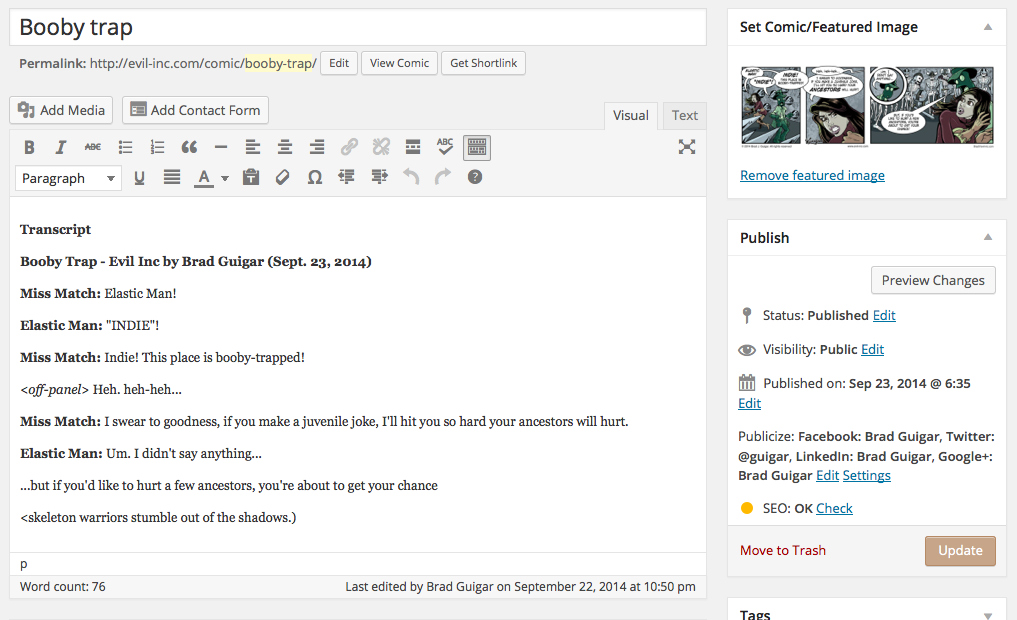
 Please use the Set Feature Image option (it’s in the right-hand column) to upload your comic.
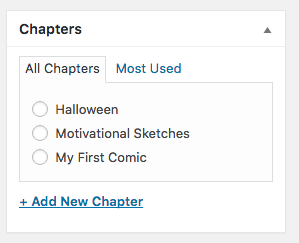
Be sure to select the Halloween chapter tag (see image to the right).
You can even add a headline and text. In the text, you can link to your comic.
No explicit content (text or images) will be approved.
I will accept pieces right up until the 31st — but I can’t guarantee that submissions made past the 29th will be approved/published in time. There’s no page limit for people submitting multiple-page comics.
Ames lettering guide
The Ames Lettering Guide is a little daunting when you begin to use it. For general use, I’m going to suggest ignoring the holes on the left-hand side of the tool as well as the metric measurements.
Before we get started, let’s cover some typography terms.
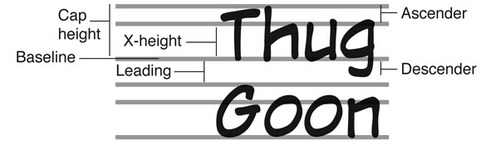
You can use the Ames tool to measure out Cap height, X-height and leading. It’s an ingenious little tool. Here’s how it works… [read the entire post — no subscription needed!]
 Twitter to loosen up its 140-character limit
Webcomics.com was among the first to give you the heads-up that Twitter’s announced change was about to take place. We gave you the heads-up on what to expect — and how to exploit it to your advantage! [Sign in to read the entire post]
“How do I get more readers?”
Today we’re going to talk about a sentence that every last one of us have uttered:
I really feel like if I could get more people to see the comic they would actually like it…
There’s not a webcartoonist alive who doesn’t feel that way. Heck, I would imagine it applies to any creative profession. It’s one of our very few Universal Sentiments.
But it’s a mindset that misses an important point, and until you understand it, I think it’s going to hold you back.
What I think you’re missing is this: You’re already getting new readers. Every day. The question you should be asking yourself is whether you’re keeping the new readers you do get. And if that answer is no, you have to take a long, hard, objective look at why that is. If you think your comic is good — and if you’re not keeping new readers — then maybe it’s not as good as you think it is. [Read the entire post — no subscription needed!]
“How long does it take to succeed?”
If you saw this on my Twitter feed…
…this is what I was talking about:
I posted a link to this Webcomics.com post on a Facebook Group for webcartoonists. In the post, I argue that we cartoonists shouldn’t focus on trying to get a million new readers. Rather, we need to focus on retaining those incidental readers who stumble across our sites every day — and slowly cultivate those people into fans. A webcartoonist — I’ll call her Ms X — took a different point of view. The exchange was fascinating, and I want to share it with you here so I can address one of the main topics it raises.
Here’s our conversation… [sign in to read the entire post]
The future of ad blockers?
 There’s no doubt that ad blockers have caused a massive change in business plans for web publishers. But… is this change permanent?
Today, the Verge reports that Ad Blocker Plus will strip ads from sites — and replace them with… ads. From the Verge:
Adblock Plus is launching a new service that… uh, puts more ads on your screen.
Rather than stripping all ads from the internet forever, Adblock Plus is hoping to replace the bad ads — anything it deems too big, too ugly, or too intrusive — with good ads, ones that are smaller, subtler, and theoretically much less annoying.
According to the report, Ad Blocker Plus had been doing this in a scaled-down version since 2011. It would (for a fee) “whitelist” certain ads that would show despite the block.
In commenting on the story, the Ad Blocker Plus spokesperson revealed, perhaps, more than they intended… [sign in to read the entire post]
 Calendar reminder
Just a quick reminder that if you’re planning to produce calendars to sell at the end of the year / beginning of next year, this is the time to start. Here’s what you need to get moving in the right direction… [sign in to read]
The Webcomics Three-Step Program
Step One: Do a good great comic.
Step Two: Don’t fool yourself about Step One
Step Three: Monetize. Gradually.
We’ve been talking a lot about the concept of Success* this week, so maybe it’s been on my mind a little more than usual. But it seems like everywhere I look, there’s a cartoonist who is scratching their heads wondering why Success isn’t happening for them — particularly financial success. And I look at their comic, and it’s…
…horrible.
Amateurish. Poorly drawn. Poorly written. Poorly executed. Fails at new-reader retention. Poor social-media outreach.
And I stare in my screen in amazement.
Do these people really expect others to pay for this? Do they even see the difference between their work and the work that is earning financial success? [sign in to read the entire post]
“What a waste of time!”
I was lucky enough to get a generous review on io9.com a few years ago. And in the comments section under the review, the response was overwhelmingly positive. I was being tweeted, and e-mailed and Liked.
It was a really good weekend.
Until I read this.
I tried giving this comic a read, and it wasn’t funny at all.
What a waste of time.
My pageviews were astronomical. People were clearly pouring through the archives. And the positive comments were kind to say the least. Obviously, I was doing something right.
But you know which comment stayed with me: “What a waste of time.” [You can read this entire post free!]
 Patreon — Real-time backer survey
Patreon is rolling out yet another improvement in its creator-side user experience.
If you go to your Dashboard, you’ll see a Summary at the top. This is being updated on a daily basis — and possibly more frequently. There has been no official notification — and some creators may not see the change implemented yet — so stay tuned. But it’s definitely an improvement I’ve been hoping for.
Why? [sign in and read the entire post]
Creative Commons and the question of commercial use
 When Creative Commons licensing came out, I was skeptical. I’m supposed to assume that the garden-variety user knows CC BY-NC-SA from CC BY-ND?! Heck, I’ve got to refer back to the post before I cover the topic for my students at Hussian College.
It doesn’t help when an organization tries to enforce a baffling interpretation of those concepts. From Arstechnica:
… Great Minds … has developed K-12 curriculum used by schools across the US. The materials developed from the Washington, DC-based nonprofit hold US copyrights but are made publicly available under a Creative Commons (CC) license, which theoretically allows them to be freely shared and reproduced for noncommercial uses as long as the original source is credited. That CC license is known as BY-NC-SA 4.0.
But … it’s suing Federal Express, claiming the Texas-based delivery-and-copying company is reproducing its materials for teachers and schools without paying royalties to Great Minds. The educational company says that because FedEx is making a profit from reproducing the materials, it’s violating the CC license. That’s according to a federal lawsuit (PDF) the company has lodged against FedEx.
According to Great Minds, although it’s legal for a school to reproduce its materials for use in their classrooms, if they make those copies at a FedEx copy center, then FedEx owes Great Minds a licensing fee because they made money on the deal!
Here’s what that means to you as a creator… [sign in to read the entire post]
Shipping comics Media Mail
 There seems to be some misinformation going around about whether it’s legal to ship comics using the Media Mail service of the U.S. Postal Service.
Since misunderstanding this could cost you thousands, let’s get it straightened out now.
Here’s the passage on the USPO Web site regarding comics and Media Mail — with the pertinent passage in bold.
Media Mail packages may not contain advertising. Comic books do not meet this standard. Books may contain incidental announcements of other books and sound recordings may contain incidental announcements of other sound recordings. In accordance with standards in the Mailing Standards of the United States Postal Service, Domestic Mail Manual (DMM), Section 170, Media Mail packages must have a delivery address and the sender’s return address and are subject to inspection by the Postal Service™. Upon such inspection, matter not eligible for the Media Mail rate may be assessed at the proper price and sent to the recipient postage due, or the sender may be contacted for additional postage.
Here’s what that means to you… [You can read this post in its entirety — for free!]
“What is the standard comic-strip size?”
Q. What’s the standard size for a comic strip?
A. There’s no such thing as a “standard” comic-strip size — at least, not in the sense that there once was. But — over the years — a sort of accepted norm has developed. [sign in to read more]
Tapastic and LINE Webtoons
 Since the beginning of Webcomics.com, the advice was consistent. And it was a prevalent theme in “How to Make Webcomics” and “The Webcomics Handbook.” Everything you do should have the ultimate goal of driving traffic to your website. Social media, advertising, promoting at comic conventions, participating in crossover events, and so on. Your site is your hub. It’s where you solidify community-building, it’s where you sell merchandise, and it gets translated directly into advertising income.
Then, the Internet changed. Ad blockers dampened advertising income for many creators. And — as early as 2014 — I started posting pieces talking about how we, as publishers, were going to have to start rethinking our approaches.
“If you’re doing webcomics the way you were three years ago, you’re making a mistake” became a mantra here at Webcomics.com.
 To that end, I find myself reversing my opinion on sites such as Tapastic and LINE Webtoon.
I used to dissuade creators from sites like those. I wanted creators to build their own place on the web where they could exert total control over their comic, reader-outreach, merchandizing, etc.
And I still do.
But I’ve found a place for Tapastic and Webtoon in my own publishing approach… [sign in to read more]
Better keywords
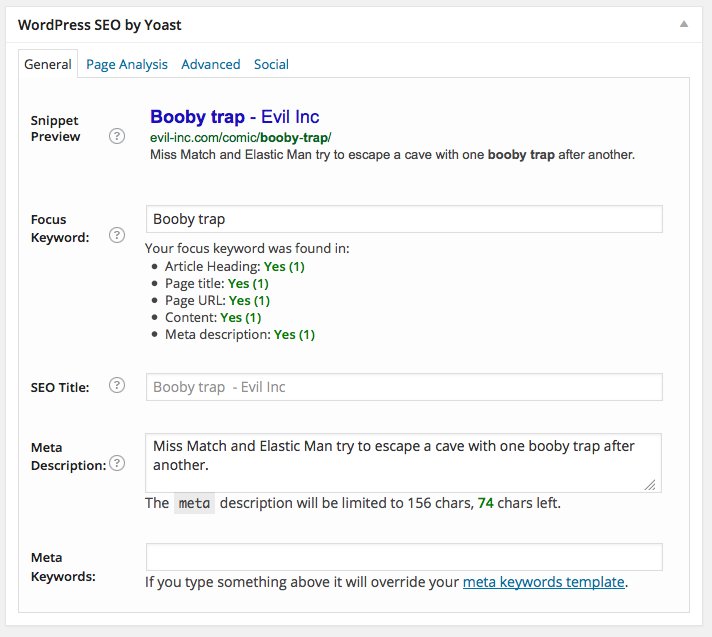
If you want to improve your SEO, you’ve got to get good at tagging your comics. Your site needs meta tags. If you use Yoast SEO (and I recommend it) you’ll be posting a focus keyword for every comic you publish. And if you post your comics on a third-party platform, you can bet you’ll be plugging in some keywords.
But what keywords should you use? Which ones get used the most — and therefore are more likely to be used by readers looking for your content?
I’ve got a little Pro Tip for you… [sign in to read more]
Yoast SEO Plug-in
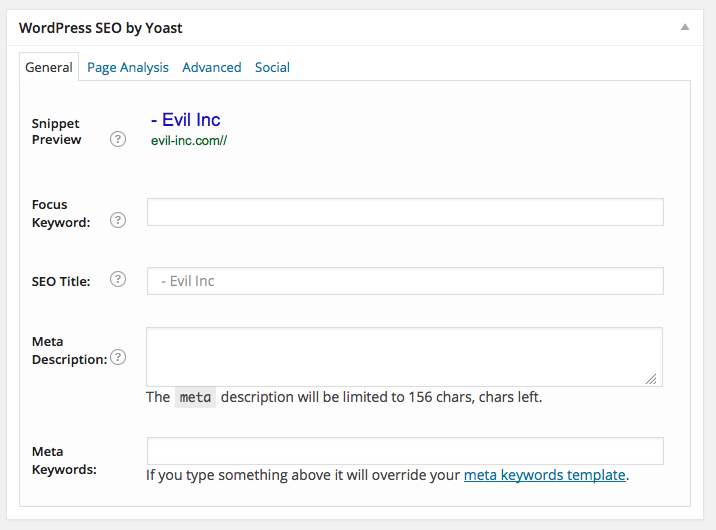
I strongly endorse the WordPress SEO plug-in by Yoast to bolster your SEO efforts. To that end, I have some thoughts on using it effectively. In short, I think most webcartoonists are using this plug-in (and others like it) wrong.
First of all, for a thorough, comprehensive tutorial to WordPress SEO, you should definitely peruse Yoast’s own tutorial. They live and breathe this stuff, and their tutorials give tons of insight into how SEO, in general, works.
Here’s my personal approach to using this tool. [You can read this entire post for free!]


















 Loading ...